Common collects the foundations and recurring possibilities of Cosmic Milk. It does not claim that all cultures follow one law, share a spoken language, or inhabit equivalent physical environments.
Foundations of Existence records the setting’s foundational commitments. Other notes describe living practices, forms of life, and environments that can appear across multiple local histories. Their recurrence does not mean that every civilization has encountered them.
Ways into the whole
-
Cosmic Milk, Cosmic Milk — The Flowing Inheritance, and Cosmic Milk — Visual Language: cultural and intellectual inheritance flowing between civilizations, and the imagery through which it can be expressed.
-
Language Structure, Naming and Translation, and Common Lexicon: words, names, and what translation leaves unresolved.
-
Scale and Encounter, Time and Irreversibility, Memory and Continuity, and Wisdom in Practice: relationships between power, perception, and lived consequence.
-
The Unowned Life, The Terms of Contact, The Right to Depart, The Work of Care, and The Witness and the Record: practices through which different lives can remain in relationship.
-
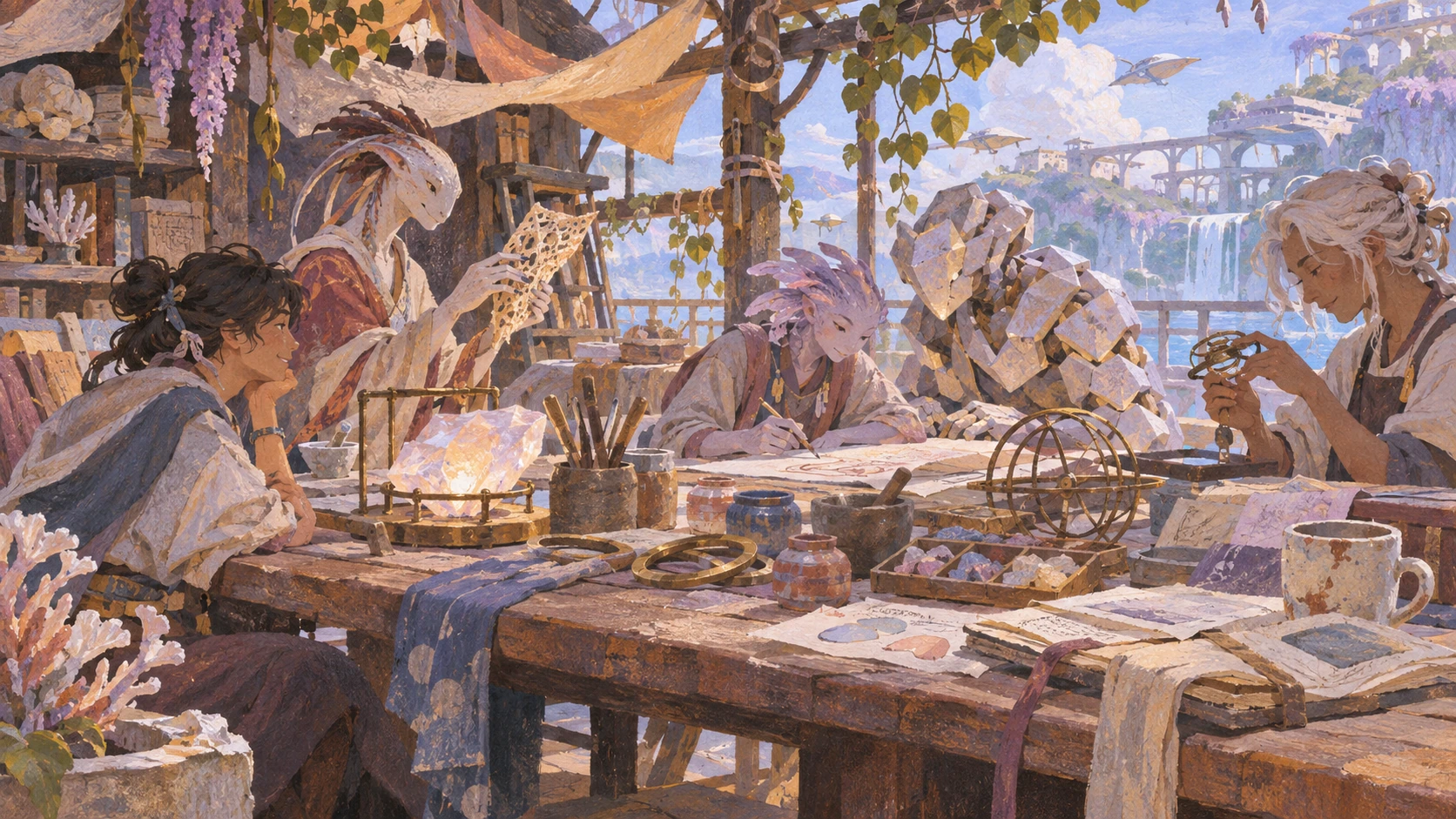
Forms of Embodiment, The Lethari, The Tessellates, and The Aural Shoals: bodies and communities that cannot be reduced to a single human model.
-
Habitat and Incompatibility, The Littoral Between Worlds, and The Salt Libraries: environments shaped by conditions, maintenance, and history.
-
Art Across Different Senses, Architecture of Encounter, and Objects That Outlive Their Makers: art, shelter, and material memory.
Relations to local histories
The Age of Open Hands is one inhabited historical region. Its visual style and protocols are specific expressions, not a universal look or compulsory cultural destination. New eras can develop other forms without contradicting these common foundations.
The Age of Many Horizons develops one such region: technologically mature civilizations whose contact network spans several universes and layers. Its machinery is locally established; it does not supply universal mechanisms for all existence or rank lives by their layer.
The named species here are established inhabitants of the setting, not replacements for the Veyr, Serein, Orun, or Nacre’s distinct embodiment. Their local settlements and historical appearances can be developed where stories need them.
An unknown destination remains unknown. A metaphor does not become a machine. An observed pattern does not grant a civilization complete knowledge of infinity.
Generative themes across the eras
The Age of Open Hands and the Age of the Captive Moon have inspired the following common lenses. These lenses can support other worlds; their cultures, institutions, local geography, and disputed claims remain local.
- The Unfinished Horizon: a familiar account challenged by what lies beyond it.
- Knowledge That Has Lost Its Hands: records preserved after their living use disappears.
- Mercy Without Innocence: care after the giver must face harm they have caused.
- The Weight of a Small Life: a particular consequence within immense scale.
- The Silence of the Powerful: restraint questioned by an unmet need.
- Symbols and the Work Beneath Them: public images and the material lives sustaining them.
- Thresholds Without Ceremony: a transition understood only through later encounters.
- The Lives We Cannot Recognize: attention beyond familiar bodies and assigned status.
The corresponding dictionary entries are Horizon, Living Knowledge, Dignity, and Restraint.
These are conceptual and artistic resources. They do not make every world two-faced, every powerful being a tree, every civilization a caste society, or every story follow the same historical trajectory.
Standard Galactic research seeds
Standard Galactic Research Review records the source reading, critical distinctions, and creative adaptation. Standard Galactic Link Catalog inventories 385 unique profile links with access and reading status.
New inspiration notes explore Paths Without Doors, The Work That Makes Repair Possible, Permission to Mend, The Purpose Someone Else Chose, What a Claim Leaves Behind, Rooms That Help Us Think, The Climate Kept Awake, Before a Thing Has a Use, The World Between Glances, and An Unfinished Thing That Still Lives.
They remain marked as inspiration rather than universal laws. The related working terms are Admissibility, Recoverability, Projection, and Exaptation.
Exploratory places, play, and discovery
A Coast Worth Visiting introduces a connected set of exploratory drafts on Rillune: The Long Chime, The Foldfin Grazers, Music for a Moving Shore, The House Above the Listening Steps, Things Rillune Children Know Are Impossible, and The Ninth Note in the Dry Basin. They explore one natural phenomenon through feeding, art, coastal navigation, holidays, folklore, and a small investigation. These proposals are not established canon and have no assigned era or route from existing locations.
Seven Ways into an Inhabited Infinity connects seven further exploratory proposals: a restaurant for different bodies, a wandering ecosystem, a friendship across unequal days, a local sport, an Iriath investigation, Meridian-era cultural objects, and neighbors’ lives after work. The restaurant and garden receive linked development notes; all new places, people, practices, and proposed events remain exploratory.