A civilization can die while something it learned is still arriving elsewhere.
A way of binding a wound travels beyond the hands that invented it. A theorem crosses a border its author never crossed. A song finds a mouth unlike any mouth its first singer could have imagined. Cosmic Milk names this flowing body of culture and knowledge: the inheritance civilizations receive, transform, and carry into one another’s lives.
Rivers without a first spring
Within infinite existence, no single civilization owns the beginning of all knowledge. A particular river has a history; a particular teaching has makers, witnesses, and debts. Infinity does not dissolve those histories into anonymity.
An inheritance can travel through a conversation, a displaced household, an archive, an apprenticeship, or an encounter between worlds. Where contact across layers is possible, its scale and conditions still matter. No river is assumed to reach every shore.
What nourishment asks of us
Milk is an image of sustenance. What reaches another life must become usable there, and that becoming may alter it deeply. A building tradition devised for breathing bodies cannot simply be handed to beings who inhabit currents of sound. Translation asks what the practice was caring for, as well as what shape it took.
Living Knowledge concerns the relationship between understanding and practice. Cosmic Milk concerns their circulation between civilizations. The two meet when a received record finds new hands, or when a gesture outlives the words that once explained it.
The receiver participates in the inheritance. They may correct it, refuse it, or discover that its promised nourishment conceals an obligation to obey. Gratitude cannot be demanded as the price of learning.
Sediment in the current
The river carries grief and error too. A medicine may arrive with a false account of the people who discovered it. A beautiful song may preserve the language of conquest. A rescued archive may contain instructions whose victims were never permitted to leave a record.
To inherit responsibly is to listen for those absences. Wisdom does not make the current pure; it helps lives examine what they carry onward. Protocols can sustain sharing, correction, attribution, and refusal without requiring one institution to own the river.
Neither abundance nor interruption is automatically just. A civilization can keep others hungry for knowledge it could share. It can also flood another world with answers until the inhabitants lose the room to ask their own questions.
A small vessel
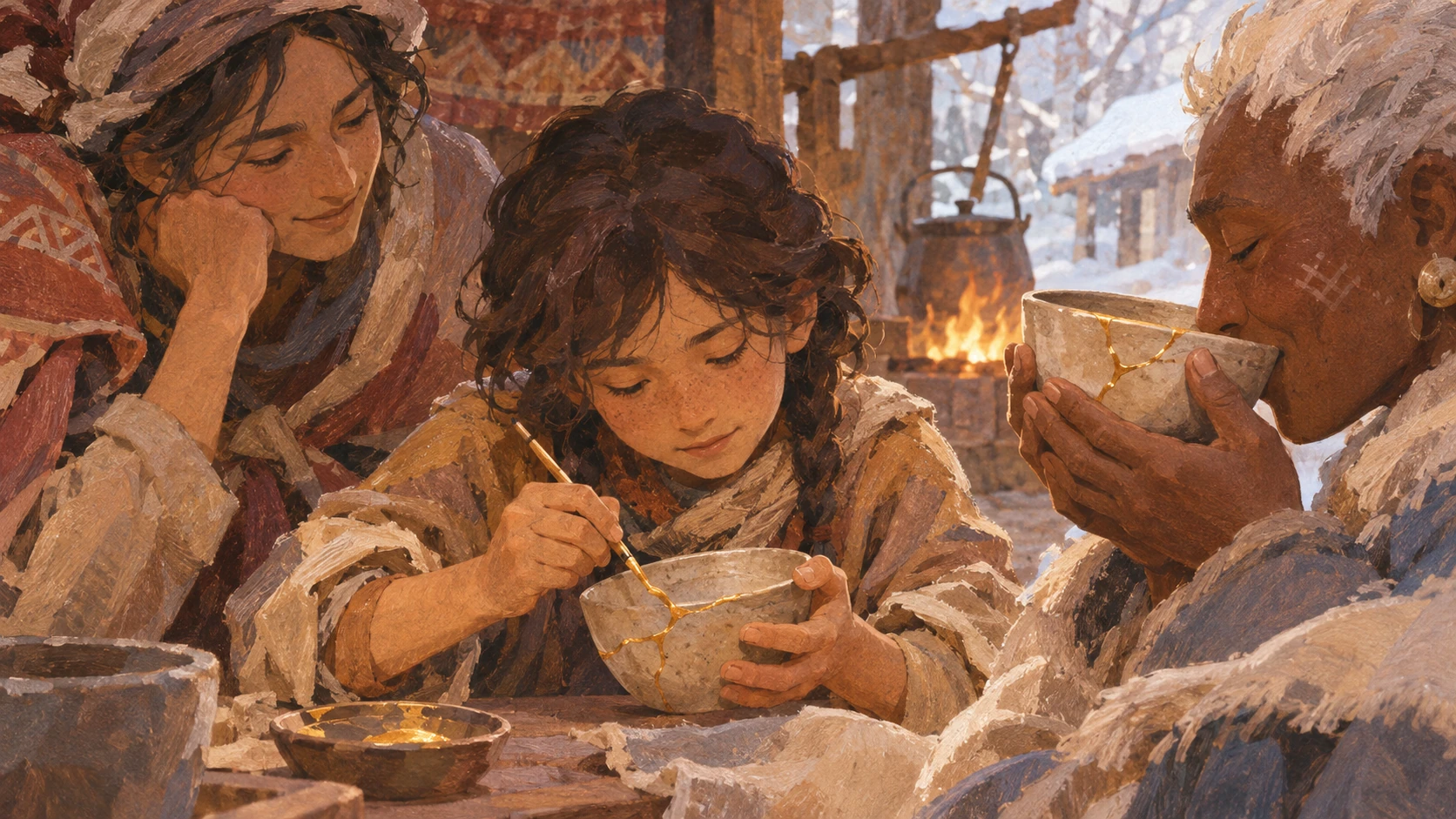
A child learns to mend a cup from a traveler. Years later, during a winter the traveler never lives to see, the child repairs a stranger’s bowl. No one in the room knows the first teacher’s name. The stranger eats from it with both hands.
Cosmic Milk can be immense enough to connect worlds and intimate enough to pass through that repair. Its scale does not make the bowl less important.
Relation to the eras
The Age of Open Hands can explore deliberate circulation, reciprocal learning, and the labor that keeps a gift available. The Age of the Captive Moon can explore interrupted inheritance: a surviving book, a lost practice, a child whose questions restore movement to something the community believed had become meaningless.
These are possibilities for local stories. Cosmic Milk belongs to neither era alone, and participation does not require a civilization to use this name or share its imagery.
Related: The Work of Care, Knowledge That Has Lost Its Hands, The Witness and the Record, Permission to Mend, Cosmic Milk — Visual Language.