Salt Libraries are archives whose makers record selected patterns in cultivated mineral growth. They exist in multiple local traditions rather than as branches of one universal institution.
Growth conditions influence what is preserved. Reading often requires equipment, time, and a context that the crystal itself cannot contain. A library can preserve an astonishingly delicate record and still lose the account explaining why it was made.
Rooms and weather
A library contains controlled chambers, work tables, carriers, and ordinary maintenance routes. Dust, moisture, and incompatible visitors matter. Public access may occur through reproductions that disclose their own limits.
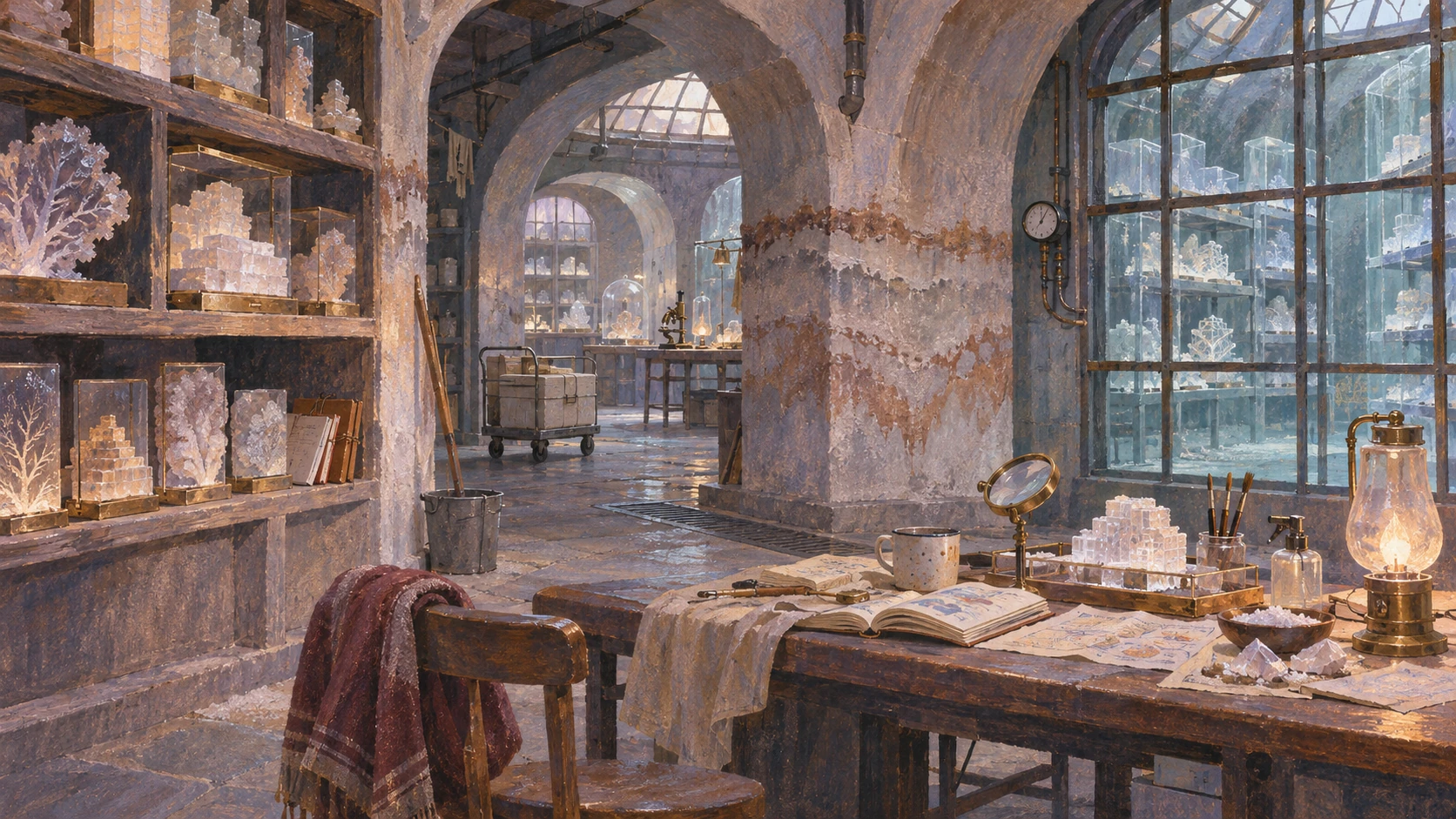
Some chamber walls carry old tide marks. These are histories of flooding and recovery, not proof that the archive exists outside time.
What can be kept
A lattice can hold a testimony, a model, an environmental pattern, or a musical construction within the technology of its local makers. It does not store ideas as physical objects, and it does not imprison the dead.
Loss remains possible. Damaged records may be partial or unreadable. Reconstruction can add assumptions; ethical readers identify them.
The custom of the unnamed shelf
Several libraries reserve a shelf for records whose context is missing. They do not label those records meaningless. Neither do they announce that every unresolved pattern contains a profound revelation.
Visitors sometimes leave a contextual account beside an old record. The new account remains distinguishable from the older material. This modest separation has prevented both rediscovery and grief from becoming an excuse for forgery.
Related: Memory and Continuity, The Witness and the Record, Art Across Different Senses.