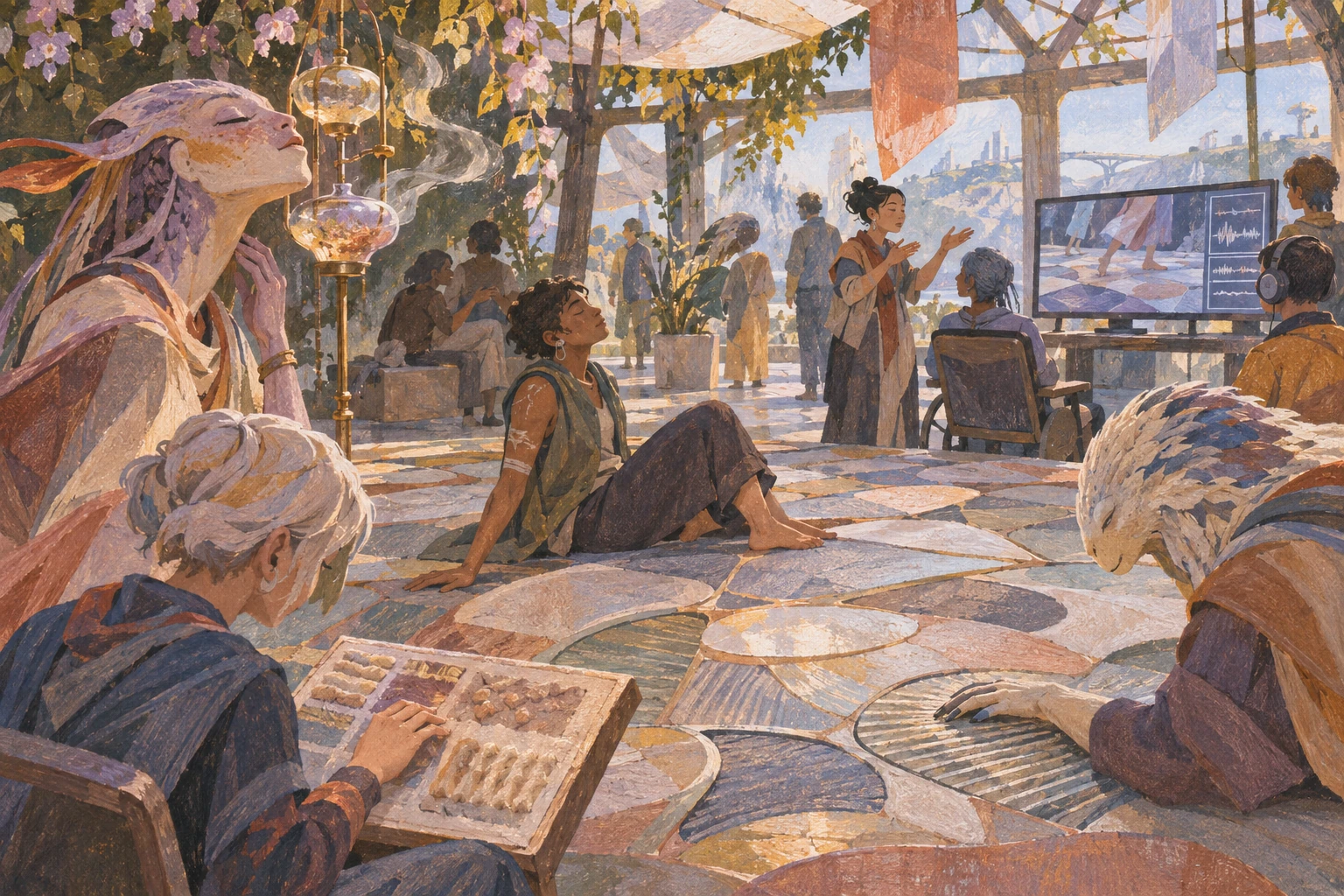
Art in Cosmic Milk is not limited to visible images or audible speech. Different bodies create relationships through texture, chemical change, vibration, movement, pressure, light, and sequences of material transformation.
No sensory form is universally accessible. Translation can create a valuable second work without reproducing the first encounter.
Performance and participation
A Lethari scent composition changes with humidity and with the participants’ movements. An Aural Shoal performance inhabits a volume of air. A Tessellate floor work can be felt through resting components and misread as ordinary silence by a visitor.
Artists can provide parallel forms: a tactile score, an annotated film, a vibration surface, a spoken description. The alternatives need not pretend to be interchangeable.
Public and private art
Some artworks require a relationship with the maker or a particular place. Others circulate widely. Neither accessibility nor exclusivity is automatically a virtue. A public display can welcome unfamiliar bodies and still expose people whose participation was meant to remain local.
Beauty after harm
Objects made under despotism can retain beauty. Survivors may inhabit, alter, reject, or reinterpret them. An artwork’s excellence does not erase the relationships through which it was produced.
Commemoration can give loss a public form without granting the public ownership of grief. An anniversary should not require a living organism to ignore its needs for the sake of a spectacle.
Visual depiction
A comic must distinguish its own image from the experience it represents. It can show bodily responses, the place, the work involved, and the limits of translation. Glowing shapes should not become an automatic shorthand for every nonvisual art.
Specific eras choose their own visual language. The Age of Open Hands has a regional production guide; it is not the only legitimate aesthetic of infinity.
Related: Naming and Translation, The Witness and the Record, Objects That Outlive Their Makers.