The Lethari are rooted beings with mobile seasonal bodies. A mature individual grows a low fan of translucent leaves around a protected central tissue. When local conditions permit, it produces a small walking body connected through an exchange of nutrients and chemical signals.
That body is an active expression of the individual, not a disposable servant. Damage can alter what the rooted body later remembers and can become. A season without a walking body need not be a season without a life.
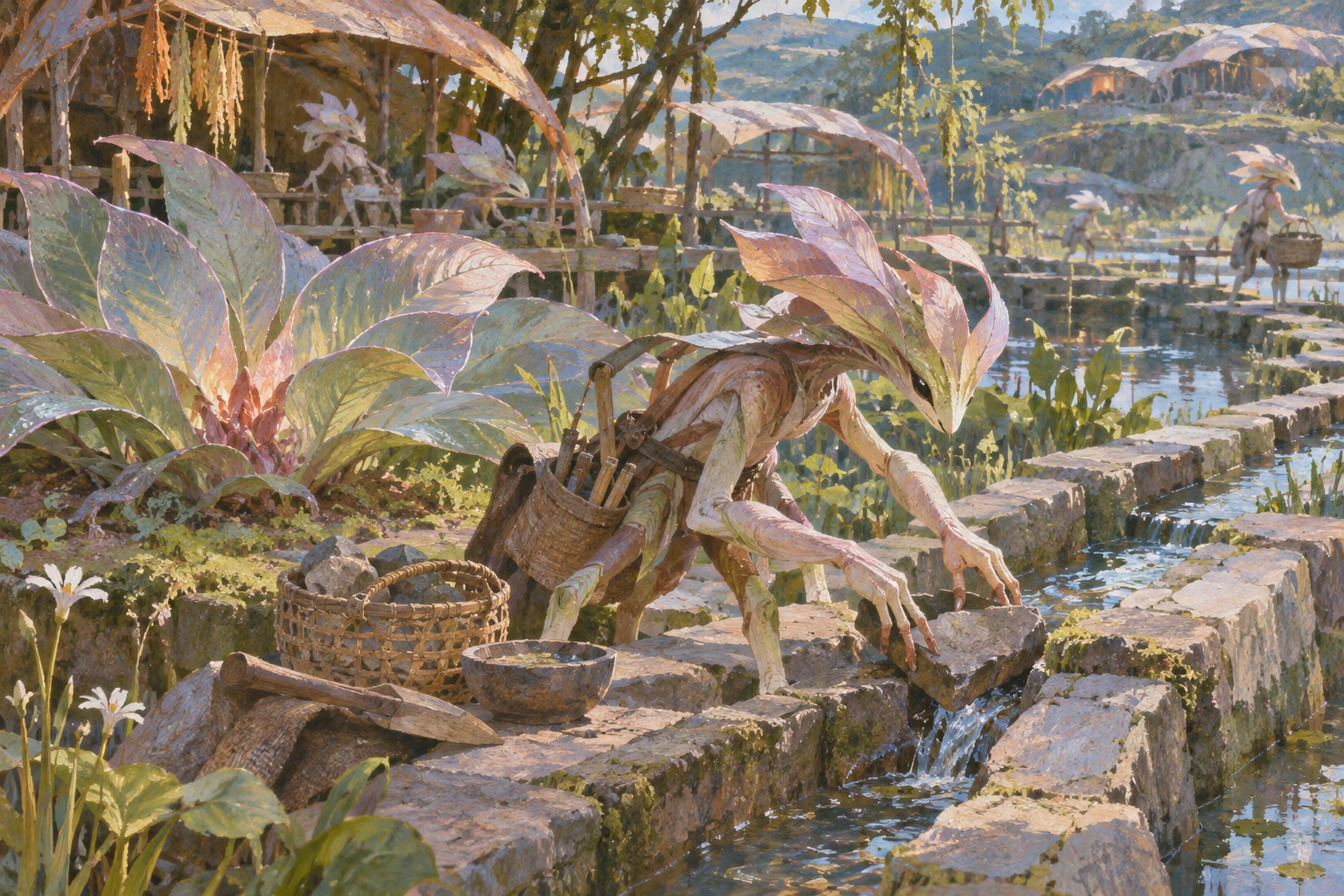
Lethari communities inhabit many suitable wetlands and sheltered terraces; no single homeworld defines the species. They are distinct from the Serein.
Perception and speech
They sense gradients through roots and air through their leaves. Walking bodies allow close tactile exchange. Visitors often notice color first, while Lethari may notice a change in moisture that the visitor cannot perceive.
Some communicate public accounts through prepared scent sequences with tactile annotations. Translation requires both sequence and circumstance: a message released in dry air can be distorted.
Household life
Shared water channels make neighbors materially interdependent. A damaged channel can become a family conflict, an engineering task, and a political issue at once.
Some communities reserve movement seasons for travel. Others remain near their rooted bodies. Neither practice defines intelligence or courage.
A recurring custom
In several settlements, a departing walking body receives a pouch of home soil. The pouch is practical while the body adjusts to a new environment, and emotional after the adjustment is complete.
Visitors sometimes mistake this for a universal ritual. Some Lethari dislike the custom because it makes departure feel provisional forever.
Related: Forms of Embodiment, Naming and Translation, The Work of Care.