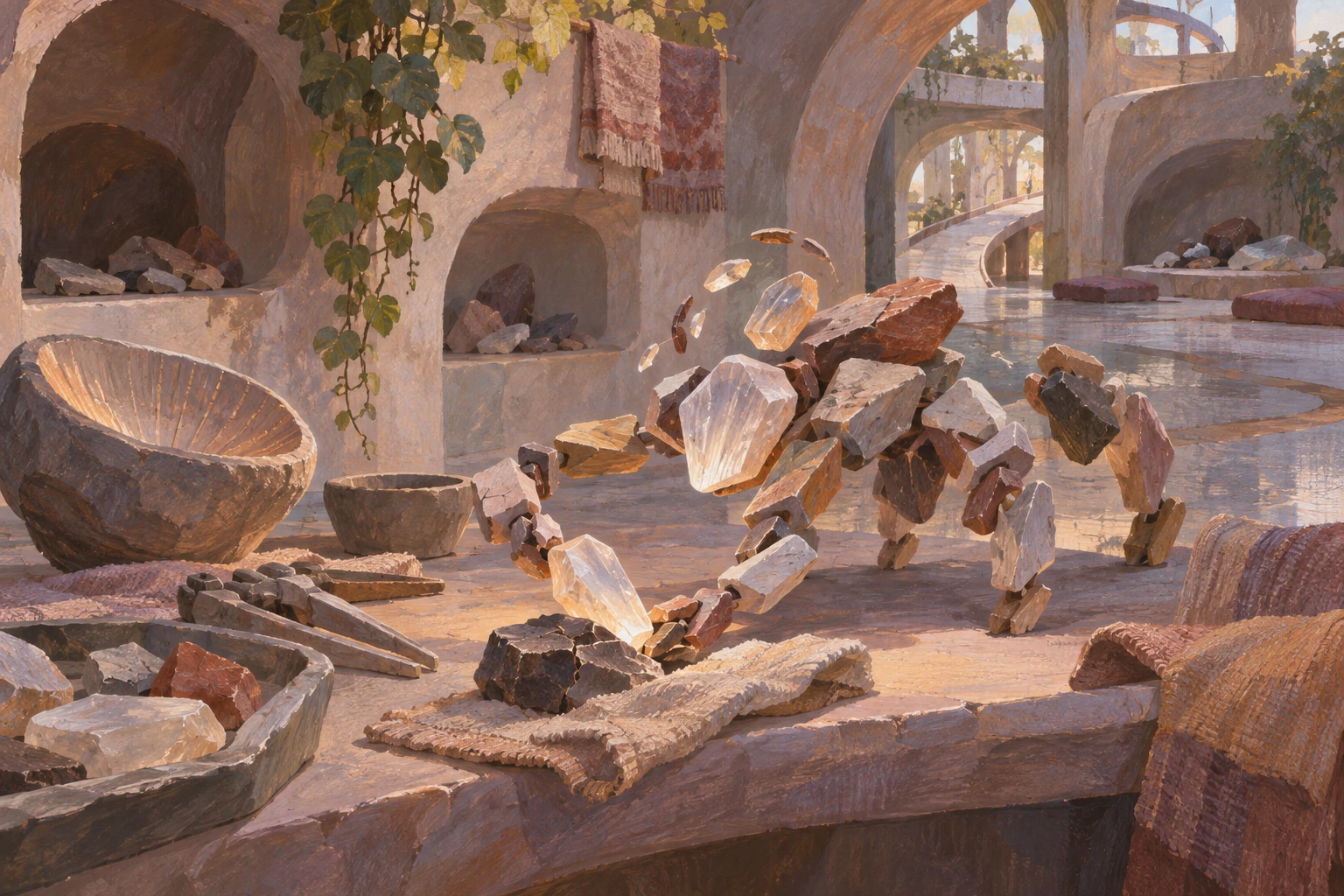
The Tessellates are lives sustained by coordinated activity among small mineral-bodied components. Components differ in function and history; a stable arrangement is not simply a pile of identical stones.
A typical mobile individual maintains enough active components to support sensing, movement, and continuity while leaving others at rest. Exact arrangements vary. Losing a component can remove a capacity or a particular continuity of memory without ending every aspect of the life.
They are not automatically the same kind of being as Nacre. Similar outward materials do not establish biological or historical identity.
Contact
They communicate through vibration, timed movement, and contact surfaces. Public speech can use a resonating vessel; one vessel may carry several individuals’ contributions without merging them into one person.
Quiet for a visitor can still contain Tessellate conversation. A loud floor can make a gathering inaccessible.
Architecture and belonging
Buildings provide resting recesses, compatible routes, and surfaces that do not overwhelm communication. Homes can include widely separated recesses; a room need not contain the entirety of one resident.
Some communities consider a shared arrangement a temporary household. Others prohibit such combinations because of histories of coerced integration. Species membership does not settle that disagreement.
Repair
A new component can support continuity without reproducing everything lost. A polished replacement may be welcomed or rejected. An old fracture can be retained privately and hidden publicly.
One tradition returns retired components to a quiet floor where visitors may sit without asking for a story. The floor is a place of remembrance, not a storehouse of extractable souls.
Related: Memory and Continuity, Architecture of Encounter, The Right to Depart.