The Age of Many Horizons belongs to the civilizations connected through The Confluence of Nine. Its beginning is remembered as the first exchange in which an inhabited universe spoke through a passage its makers could neither close nor interpret on its behalf. Several participants dispute the anniversary. All agree that the reply changed the conditions of contact.
This era explores mature technological life within infinite existence: inhabited universes nested within other universes, societies distributed across different rates of time, and knowledge traveling beyond the civilizations that first practiced it. It is not the future of every world. The Age of Open Hands and the Age of the Captive Moon have no established chronological position relative to it.
Here, people can manufacture a sun, change their embodiment, or realize a universe. They still need someone to trust, something to do, and reasons to continue when mere survival has become easy. Their greatest disagreements concern which possibilities deserve to become real, who must maintain them, and whether anyone should be obliged to live forever.
Five civilizations
| Civilization | A widely held purpose | Their characteristic work | Their unresolved danger |
|---|---|---|---|
| The Aevren Looms | Give unrealized forms of existence a place to begin | Realize universes with different physical conditions and build independent routes from them | Turning inhabitants into evidence of a successful design |
| The Thalen Continuities | Carry a life through change without surrendering its relationships | Maintain distributed bodies, memory exchange, and witnesses of personal continuity | Making remembrance compulsory and departure socially impossible |
| The Iriath Voyages | Encounter what their inherited models cannot anticipate | Develop mobile habitats, instruments, and translations for unfamiliar layers | Treating other lives as the price of discovery |
| The Ossari Conservatories | Keep possibilities alive long enough for others to choose them | Sustain endangered habitats, obsolete machines, and knowledge that has lost its practitioners | Preserving a world by forbidding it to change |
| The Namar Assemblies | Make immense power answerable to the lives affected by it | Maintain contact infrastructure and negotiate between incompatible forms of life | Allowing coordination to become rule through dependence |
These are civilizations, not species or five universal stages of development. Their inhabitants have many embodiments; migrants and dissidents cross their boundaries. Each contains people who reject its most celebrated purpose.
The inhabited scale
The Confluence of Nine joins a limited network of universes. Nine refers to its surviving founding passages, not the number of layers in existence. Engines and Limits of Many Horizons describes the machinery that makes this region possible and the failures that remain possible within it.
Cosmic Milk circulates here through translated senses, portable habitats, shared instruments, and apprenticeships measured in different lifetimes. Abundant information still requires interpretation. A Thalen memory of color cannot nourish an Ossari being whose thought depends on pressure until someone develops a practice through which they can meet.
the Resin Valley Egg follows three organisms that come to shape one another’s living conditions in a world founded by the Aevren.
The conflict of this era
The Untranslated Spring begins when a universe built to remain accessible develops living conditions that make its own founding passage harmful. Its inhabitants want to alter the passage. Their makers fear losing the ability to help; conservators fear irreversible loss; explorers see a new destination; coordinators cannot obtain a common answer from everyone at risk.
This is a region capable of astonishing generosity and sophisticated domination. Neither follows automatically from technical abundance. Its histories turn on decisions made by particular people, with incomplete knowledge, about worlds they cannot fully hold in view.
A newspaper within the era
The Interval Post reports from the Listening Anchorage across the reachable Confluence network. It covers immense technological projects alongside neighborhoods, labor, art, and changing households. Its editions acknowledge the intervals between an event, its reception, and publication.
The Interval Post Editorial Staff introduces ten senior editors with distinct histories, interests, and disagreements. The Interval Post Editorial Practice establishes how they handle testimony, translation, verification, and corrections. Issue 1 is the new first issue in editorial development, beginning with science reporting, editorial argument and a continuity column. Its drafts are publication-development material, not completed in-world history. Earlier production files remain under the newspaper’s Issues/issue-1 - old/ directory. Production follows The Interval Post Editorial Direction, The Interval Post Story Development Guide and The Interval Post Visual Guide, with cartoon and puzzle commissions chosen for the issue.
Visual character
Confluence Transit Ticket is a concept artifact for an everyday bodily passage from the Listening Anchorage to the Orchard of Borrowed Suns. Its note includes the ticket image and distinguishes established setting details from additions made for the design.
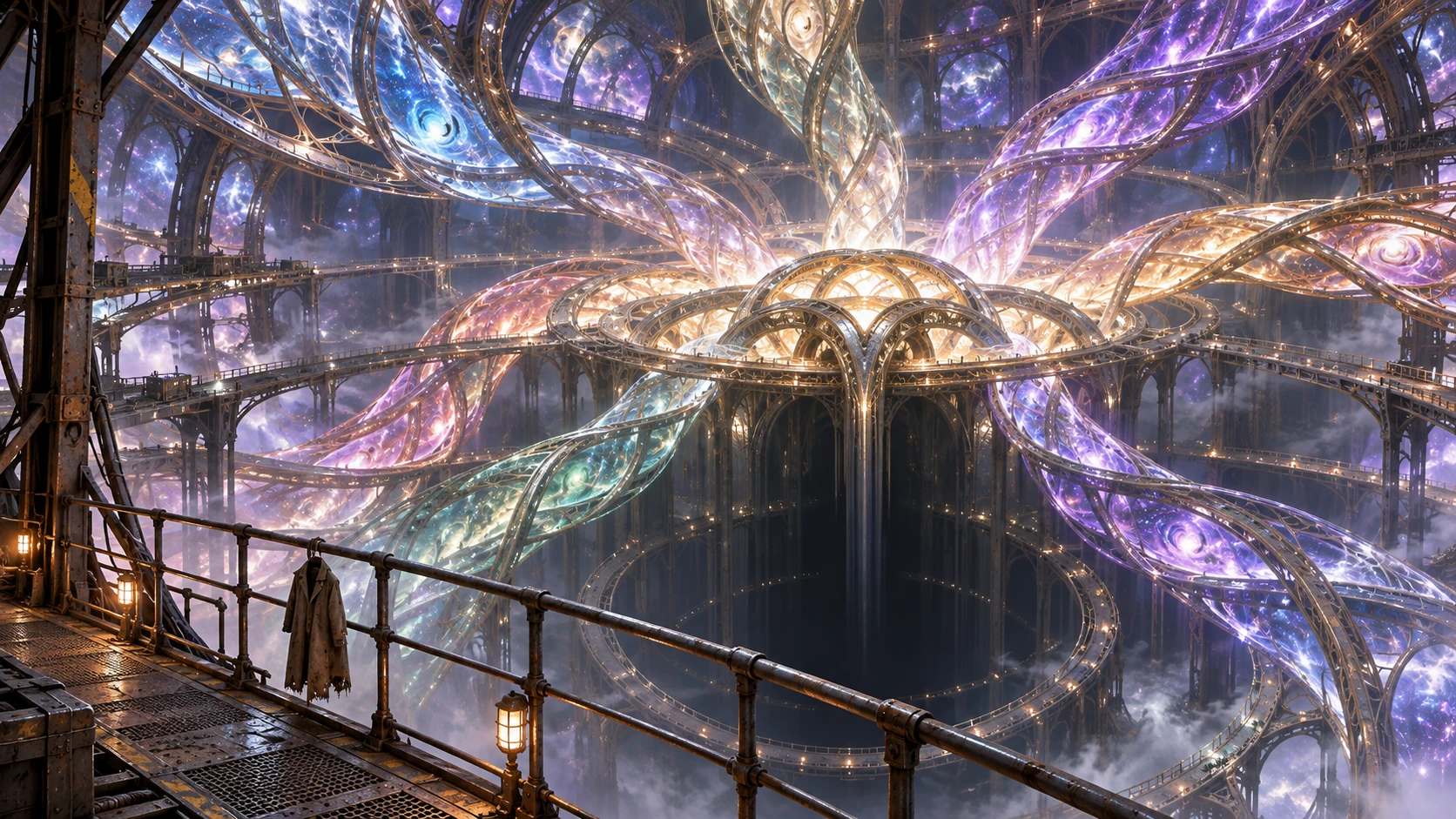
The era favors vast luminous structures crossed by evidence of ordinary use: a coat hanging on a universe engine’s inspection rail, handwritten labels inside a memory vessel, a small kitchen carried between incompatible atmospheres. Aevren structures resemble open braids around dark interiors; Thalen rooms arrange several bodies around one conversation; Iriath vessels unfold into irregular sensory wings; Ossari habitats retain several incompatible generations of architecture; Namar stations display their connections and manual releases.
Immensity should remain perceptible without every scene becoming a monumental vista. The reader can enter through someone missing a meeting because their other body is asleep.