The Ossari inhabit maintained constellations of habitats, living archives, and workshops that preserve endangered practices. Some settlements contain the last surviving environment in which a form of life can flourish. Others maintain ordinary places their neighbors regard as obsolete.
What a life is for
Many Ossari hope to leave future lives more options than they received. Their idea of inheritance includes a habitat’s living dependencies, the tools that can repair it, and people who know why the repairs matter.
Their conservatories sustain engineered stars, vanished climatic conditions, and knowledge whose original makers are dead. They cultivate translators, gardeners, and technicians together. An archive of boat building is incomplete until someone can build a boat and someone has a place to sail it.
Living and working
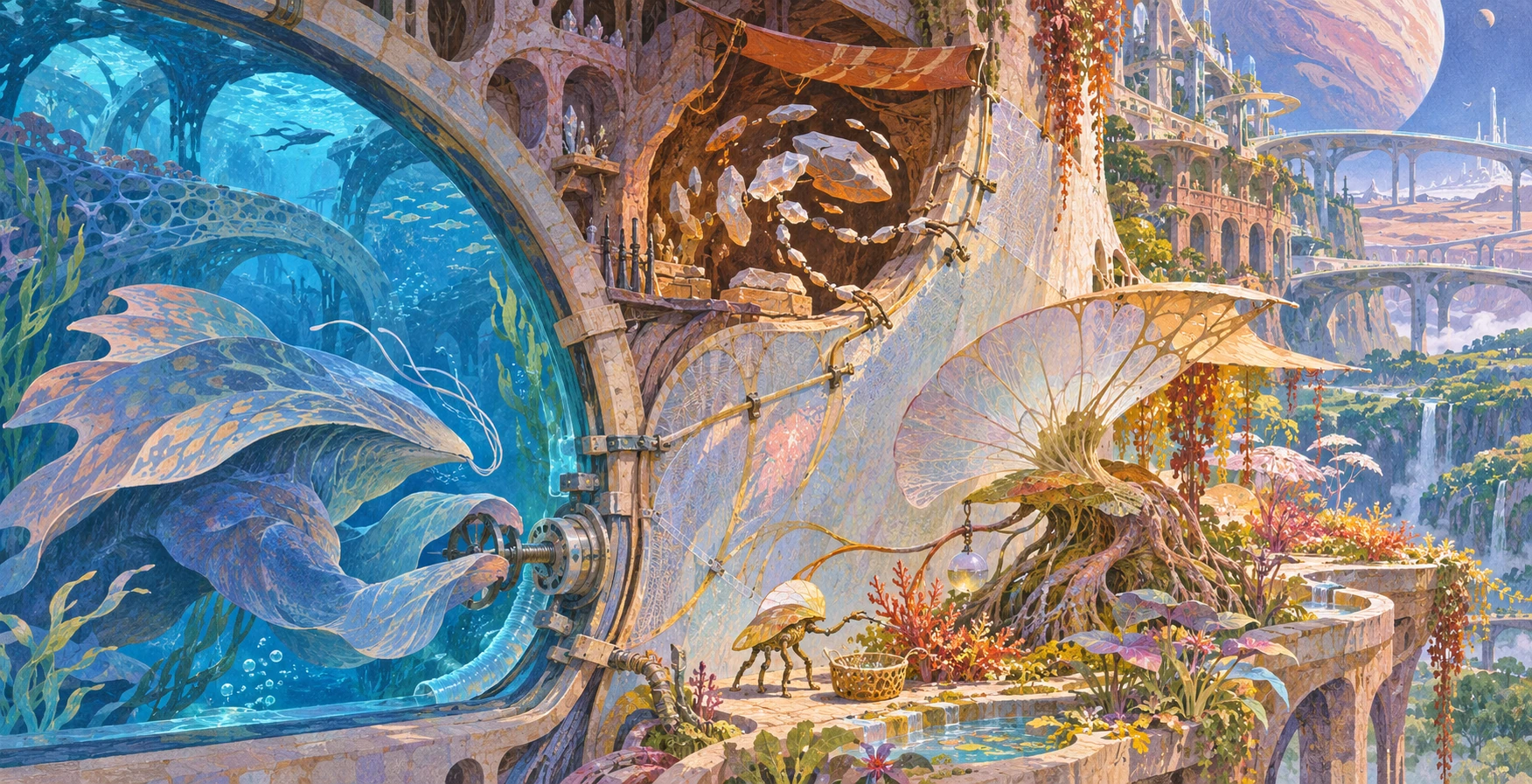
Conservatory districts can differ radically in pressure, atmosphere, illumination, and rate of experience. Neighbors meet in small negotiated rooms. Maintenance workers are unusually influential because they understand the dependencies hidden beneath an apparently effortless paradise.
Residents include descendants of rescued communities, voluntary migrants, and people born inside environments they never chose. Some love the conservatory. Others want changes that would destroy what their custodians were appointed to protect.
Ossari architecture retains working layers from successive periods. A grand stair may lead to an atmosphere most visitors cannot enter. Art includes cultivated absences: an empty chamber maintained for a species whose survival elsewhere remains uncertain. Such chambers also consume resources that current residents need.
Their disagreement
The Living Custodians let inhabitants revise the conditions of preservation. The Last-Form Trusts consider irreversible change an injury to those who cannot yet choose. Their arguments become practical when a younger generation wants warmer houses in the last habitat of a cold-dependent organism.
Their strongest blind spot is custodianship without consent. A rescued civilization can find itself required to remain culturally recognizable to retain support.
They need Aevren environmental machinery, Iriath surveys, and Namar supply agreements. They share Thalen concern for continuity while disputing whether a perfect record is worth the loss of a living practice.
Omet of the Seventh Basin maintains a refuge illuminated by an old artificial sun. His daughter wants to adapt its light for new inhabitants. He has spent a lifetime learning to repair precisely the conditions she hopes to change.