The Iriath are a civilization of expedition households, instrument makers, and settlements grown around former vessels. Their journeys follow discoverable contacts. Their oldest navigational maxim says that an accurate map must contain places where it stops.
What a life is for
Many Iriath seek experiences that make inherited categories inadequate. They develop new senses, learn foreign practices, and investigate relations between layers. A successful voyage returns with corrections to its own questions as well as useful knowledge.
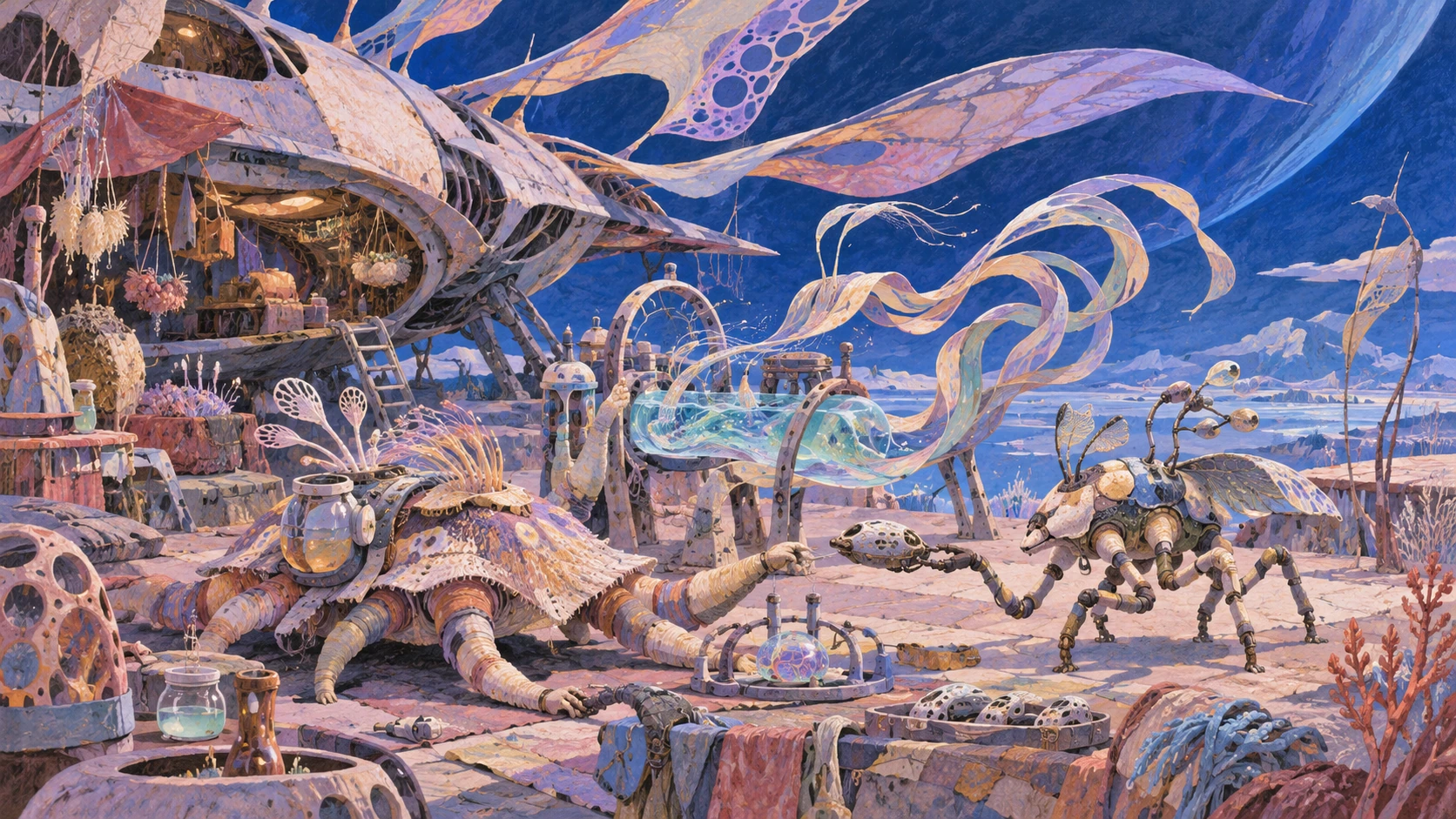
Their work includes receiving instruments for unfamiliar signals, habitats that can slowly adapt to new conditions, and survey methods that distinguish observation from disturbance. Crews sometimes spend generations learning that something first classified as weather is inhabited.
Living and working
An expedition is also a household. There are children, dependents, lovers who did not want to leave, and people hired for unpleasant maintenance. Major departures require named provision for those staying home, though wealthy captains can arrange impressive accounts that hide exhausted caregivers.
Iriath bodies often carry replaceable sensory organs. Adaptation can make a returning traveler unable to bear a familiar room’s light or unable to communicate an experience without another person undergoing surgery. Translation workers make such returns survivable.
Their vessels unfold sensory wings shaped by the conditions they investigate. Inside, worn domestic spaces contrast with instruments whose working surfaces resemble moving landscapes. Their most cherished art records a mistaken first description beside a later correction.
Their disagreement
The Listening Voyages accept long periods of uncertain observation. The Nearward Crews argue that distant caution can become indifference to people who need immediate contact. Some commercial expeditions invoke urgency to gain access to environments competitors cannot reach.
Their strongest blind spot is curiosity treated as entitlement. A discovery can ruin a community by making it fashionable, searchable, or commercially accessible even when the first encounter was gentle.
They rely on Namar routes, Thalen continuity systems, and Ossari emergency habitats. Aevren designers use their findings and sometimes forbid them from investigating the worlds those findings helped create.
Rhu of the Folded Wing builds receiving instruments. After discovering deliberate signals within a supposed dead boundary, she must persuade her own crew to surrender a profitable route before she can prove whom its operation is hurting.