What it is
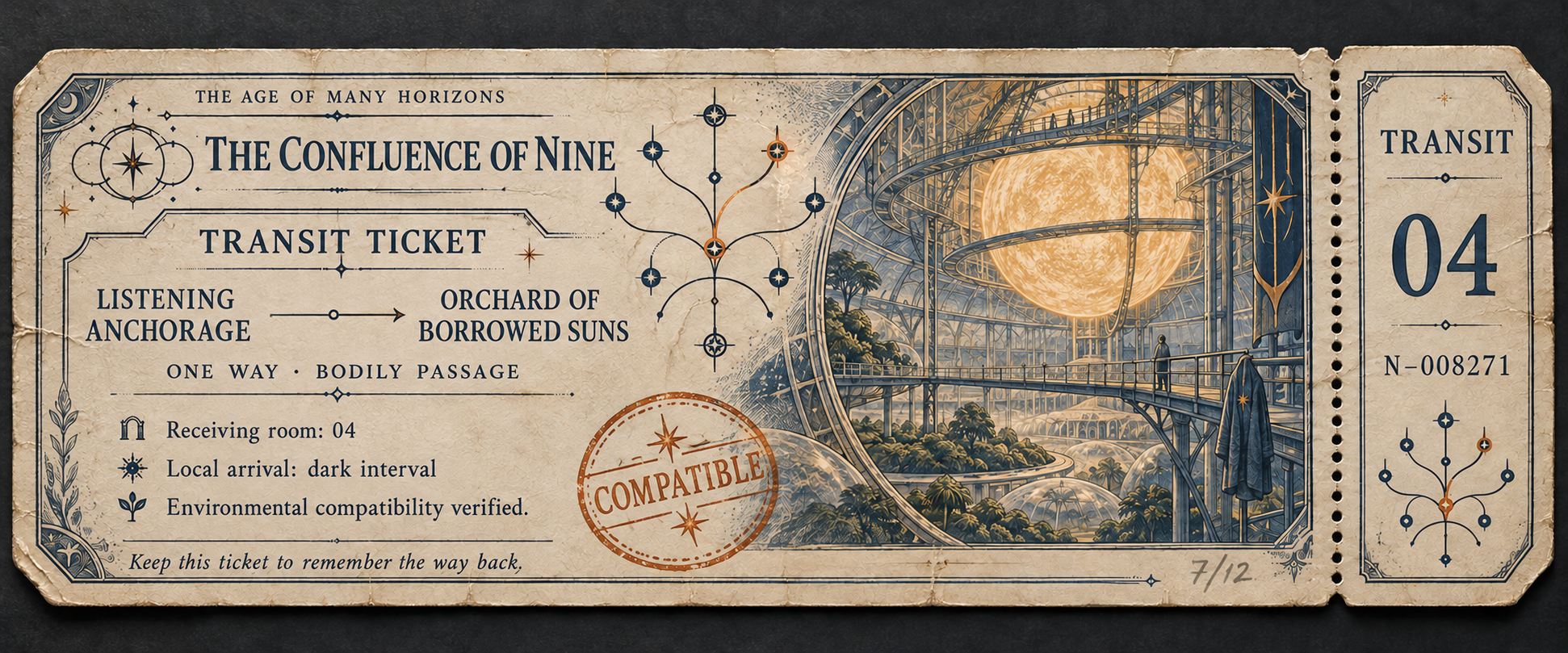
A concept ticket for everyday travel within The Confluence of Nine, designed for The Age of Many Horizons. It represents one-way bodily passage from the Listening Anchorage to the Orchard of Borrowed Suns.
Both locations are established in the setting notes. This particular service, the physical ticket, its serial number, and its operational details were invented for the illustration; they are concept additions rather than an established canonical service record.
Ticket details
- One way · Bodily passage: A connection through which the traveler’s body can pass, with compatible conditions maintained at both ends. It does not represent travel by reconstruction.
- Receiving room: 04: A room number invented for the destination’s receiving facility.
- Local arrival: dark interval: Refers to the protected periods of darkness maintained for lives harmed by continuous light from the Orchard’s engineered suns. It does not imply time travel.
- Environmental compatibility verified / COMPATIBLE: Indicates that compatibility between the traveler and the receiving environment has been checked for this journey.
- N–008271: An illustrative serial number matching the ticket to its detachable stub.
The vehicle: Night Orchard passage tender
This ticket is valid aboard Night Orchard, a small enclosed passage tender assigned to the Listening Anchorage–Orchard of Borrowed Suns service. It carries passengers inside a maintained habitat cabin through a prepared bodily passage. Its name, specifications, and operating procedure are concept additions for this artifact, using the established capabilities and limits in Engines and Limits of Many Horizons.
| Specification | Service configuration |
|---|---|
| Passenger capacity | 24 passengers in the standard single-body seating layout |
| Crew | 2: a passage operator and a habitat attendant; 26 occupants including passengers |
| Cabin layout | Four groups of six adaptable passenger places, a central aisle, a luggage bay, and two docking vestibules |
| Approximate size | 14 metres long and 4 metres wide |
| Operating environment | One agreed cabin atmosphere per departure, with adjustable light, temperature, and seating supports |
| Route | Listening Anchorage to the Orchard’s receiving room 04 |
| Typical journey | About 35 minutes of cabin time from boarding to release, including compatibility checks and docking; passage clearance can add a wait |
| Ticket validity | One passenger booking on the allocated outward departure; no return journey included |
The 24-passenger rating assumes bodies accommodated by the standard cabin layout. A larger body, several bodies traveling as one person, or a portable habitat may occupy several places. The operator confirms the actual passenger count before departure; the rating is not a claim that all forms of life fit the same seat. This tender cannot simultaneously accommodate mutually incompatible atmospheres in its shared cabin. Such travelers need a compatible portable enclosure approved for the route or a separately configured departure.
Appearance and everyday use
Night Orchard resembles a low, rounded carriage with a ribbed outer shell, docking collars at both ends, and exposed service conduits running along its sides. Its short windows have adjustable shutters. Inside are replaceable woven seat covers, handholds, luggage straps, and small handwritten maintenance labels. The attendant dims the cabin before Orchard arrivals so that opening a vestibule does not spill bright light into a protected dark interval.
How it works
- Booking and compatibility. Staff establish the traveler’s environmental needs and reserve space. The ticket’s compatibility stamp records approval for this departure’s cabin and receiving-room conditions. It is not a universal certificate for other destinations.
- Boarding. The tender docks to a sealed vestibule at the Listening Anchorage. The habitat attendant checks passengers, secures luggage and portable enclosures, and closes the cabin. Station power conditions the atmosphere and charges onboard reserves for life support, controls, and local movement.
- Preparing the passage. Operators at both ends calibrate the boundary couplers and confirm the destination’s receiving capacity. The stations supply the energy for the connection. The tender does not create a passage itself or choose an unprepared destination.
- Physical crossing. Dockside guide fields move the carriage through the prepared interface at a rate allowed by the connection’s exchange and disturbance limits. Passengers and their cabin cross bodily; they are not scanned, destroyed, or reconstructed. The sealed cabin maintains its agreed environment throughout the crossing.
- Receiving and release. The tender locks into receiving room 04. Staff verify pressure, atmosphere, and the Orchard’s lighting schedule before opening the vestibule. A traveler whose needs differ from the public habitat stays within their approved enclosure or waits for an appropriate onward transfer.
The passage is a maintained connection, not an ordinary distance the carriage can cover under its own propulsion. The journey estimate describes time experienced in the cabin; local arrival is translated into the destination’s schedule. A delay can mean missing the planned dark interval and waiting for the next permitted receiving window.
Delays, failures, and responsibility
If calibration drifts or the receiving habitat cannot accept the cabin, departure is held. Staff do not exceed a connection’s disturbance threshold to recover a timetable. Independent onboard life support allows the sealed tender to remain habitable during a docking delay, but its reserves are finite and are checked before each departure. A failed route does not guarantee an immediate return path.
For this concept service, a Namar passage cooperative maintains the couplers and public operating account; the Orchard’s habitat staff control receiving conditions and dark intervals. The two crew members handle cabin operations and passenger care. The cooperative’s name and this division of duties are design assumptions based on the Namar’s established role in contact infrastructure.
The paper ticket serves as a readable receipt and a matching record for the receiving staff. Its detachable stub is retained at boarding, while the traveler keeps the illustrated portion. Losing the paper need not erase a confirmed booking: staff can consult the departure manifest and verify the traveler through the agreed identification practice.
Visual language
Worn cream fibrous paper, dark petrol-blue printing, a copper-colored validation stamp, and a perforated stub bring advanced infrastructure into the scale of an ordinary object held by a traveler. The paper format is a choice for this concept, rather than an established standard throughout the era.
The branching route diagram evokes the nine founding passages. It is not a map of nine planets or of existence as a whole. The illustration on the right depicts an engineered sun illuminating a garden habitat, with a work coat hanging from a maintenance walkway. This small detail draws on the era’s juxtaposition of immense structures and everyday life.
The italic line “Keep this ticket to remember the way back.” is a keepsake message created for the design. It does not grant return passage on a one-way ticket.
Related setting notes
Production note
Created with the built-in imagegen tool. The English edition retains the original illustration and translates its printed labels.
Original visual brief: A worn cream paper ticket for bodily passage from the Listening Anchorage to the Orchard of Borrowed Suns in the Age of Many Horizons, with petrol-blue and copper printing, a detachable stub, a diagram evoking the nine founding passages, an engineered sun above a garden habitat, and traces of everyday maintenance.
English edition edit prompt: Preserve the original composition, paper, engraving, stamp, perforations, diagrams, illustration, and numbers. Replace all Turkish lettering with English: “THE AGE OF MANY HORIZONS”, “THE CONFLUENCE OF NINE”, “TRANSIT TICKET”, “LISTENING ANCHORAGE”, “ORCHARD OF BORROWED SUNS”, “ONE WAY · BODILY PASSAGE”, “Receiving room: 04”, “Local arrival: dark interval”, “Environmental compatibility verified.”, “COMPATIBLE”, “Keep this ticket to remember the way back.”, and “TRANSIT” on the stub. Adjust typography to fit while retaining the visual style.