The Namar grew from communities maintaining the spaces where other civilizations met. They now possess some of the Confluence’s most advanced boundary instruments, translating environments, and public infrastructure. Their civilization has no single sovereign assembly.
What a life is for
Many Namar seek relationships in which no participant must become another’s property to survive. Their admired work makes a service dependable while making its provider replaceable. A station earns esteem when its users can maintain it without asking the builders to return.
They develop independent passage controls, reversible trial environments, and records of how decisions affect people who cannot attend a negotiation. They also teach maintenance across embodiments. Their technical advantage lies in coordinating many limited systems rather than claiming one instrument can do everything.
Living and working
Assemblies form around shared dependencies: a passage, a habitat boundary, a supply network. Residents, technicians, and affected communities contest representation. An assembly for a rapidly changing route may meet every day; one serving slow worlds may carry a single unresolved question across several generations.
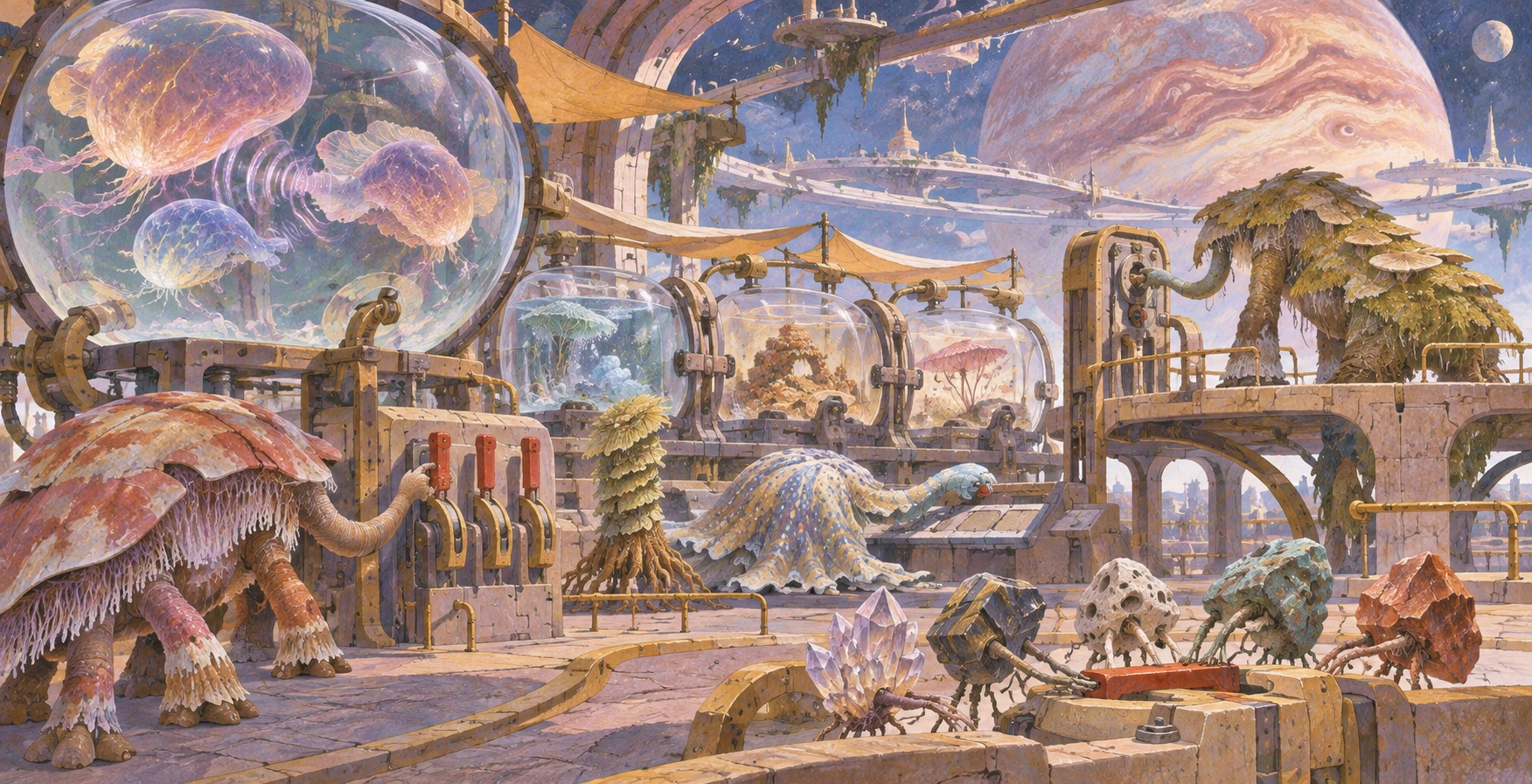
Namar daily life contains much waiting, interpretation, and inspection. Their festivals celebrate the handover of infrastructure, accompanied by teasing about the creators’ incomprehensible manuals. Station walls display manual releases beside elaborate automation. Residents test them often enough that children complain about interrupted games.
Their disagreement
The Common Passage Assemblies favor interoperable systems and shared guarantees. The Local Release Assemblies argue that common standards can quietly force unfamiliar lives into someone else’s model. Both rely on workers whose labor can vanish beneath the public language of equal participation.
Their strongest blind spot is procedural power. The society deciding how a dispute is translated, scheduled, and recognized can determine its outcome without issuing a direct command. Some Namar stations have become indispensable monopolies while still celebrating independence.
The other civilizations need them and resent them. Aevren accuse them of delaying creation; Iriath of delaying discovery; Ossari of exposing fragile habitats to change; Thalen of refusing to recognize older commitments. Namar inhabitants often share those accusations against their own institutions.
Tavi En repairs emergency releases and serves as an occasional delegate. She discovers that a celebrated independent passage can be opened freely but requires a Namar-controlled replacement part to remain open.