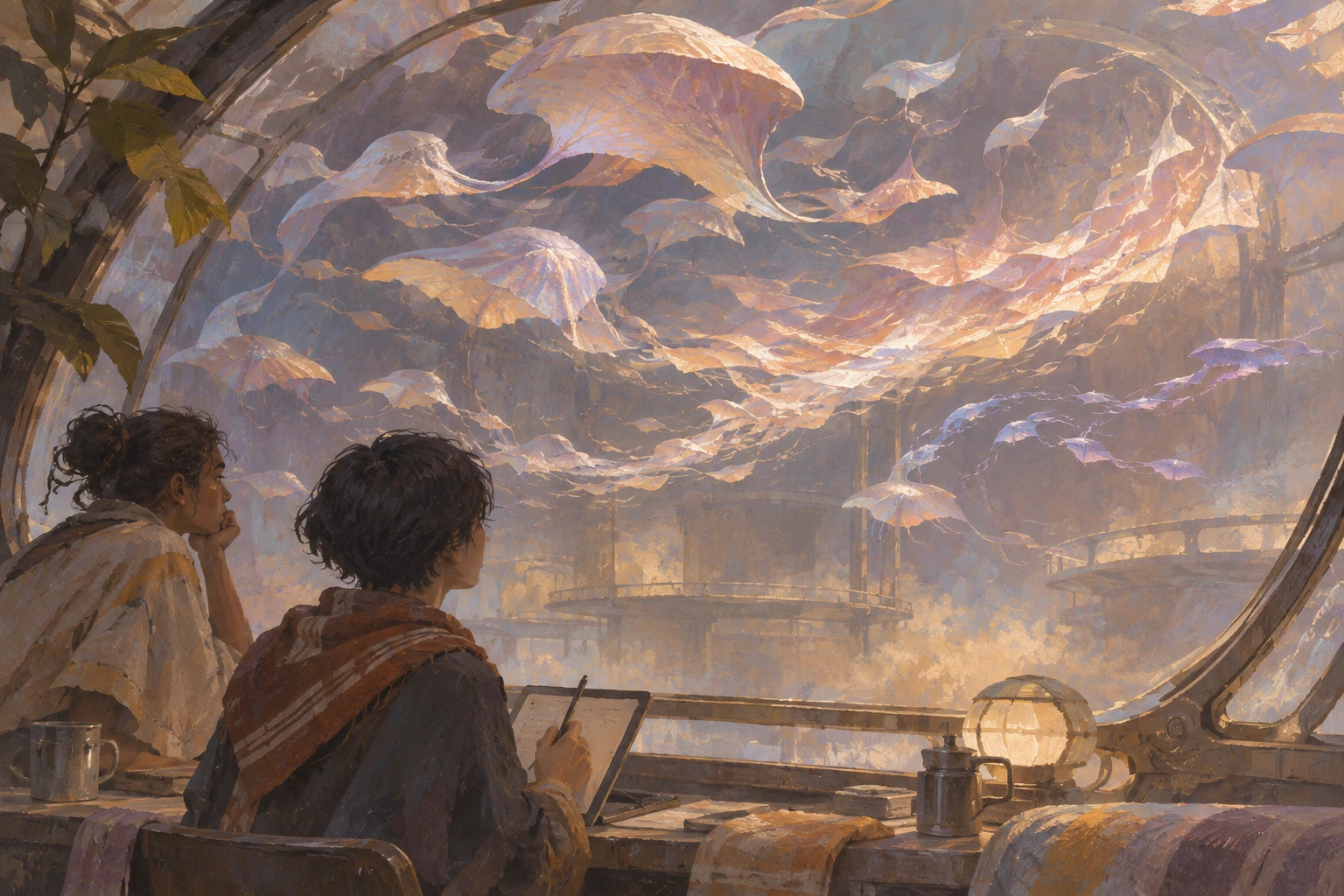
Aural Shoals are communities of airborne organisms whose individual bodies maintain buoyancy through locally produced gases and fine membranous surfaces. Their habitats require particular atmospheric conditions. They cannot survive in an arbitrary humanlike room.
Individuals communicate through pressure changes and controlled surface vibration. Groups can produce temporary patterns that support decisions no single participant can carry alone. This coordinated agency does not erase the individual lives involved.
The shared voice
A shoal’s answer can be negotiated through participation. It is not automatically the unanimous opinion of every member. Visitors who ask one group to represent the species can mistake a local decision for a universal belief.
Some groups publicly preserve dissent through an audible subsidiary pattern. Translators must decide how to represent it rather than reducing the whole answer to one sentence.
Departure and silence
Leaving a coordinated pattern changes both the departed individual and the remaining group. A participant may require rest from collective activity. Silence can be recuperation, refusal, or a loss of compatible atmosphere.
A sealed visiting chamber can allow conversation while preventing physical proximity. The separation is a condition of contact, not evidence that the guests are less welcome.
Art
Shoal performances create patterned pressure and movement across a volume. A recording for other bodies preserves only selected aspects. The original event cannot be understood entirely from a diagram of the performers’ positions.
Related: Forms of Embodiment, Art Across Different Senses, The Terms of Contact.