The Age of Open Hands is the name used around The Hinge for the present period of recovery following The Narrowing. It is not an age shared by every universe. Even here, its beginning has several dates: the first reopened passage, the first winter survived without imperial provisioning, the day a gardener stopped asking permission to grow food.
The name comes from the release of a tool. A hand that can build a universe can also close around it. Opening that hand does not erase what it has done.
Three civilizations carry much of this region’s life:
- The Veyr Houses maintain architectures and realize universes.
- The Serein Gardens cultivate complex living habitats and argue fiercely about the responsibilities of design.
- The Orun Hearths live in mobile households, with sophisticated ecological knowledge and relatively modest machinery.
They are connected by The Hinge, situated within the local universe called The Pale Reach. Their wider inter-layer relations exceed what any of them can reliably describe.
Their common life rests upon The Unowned Life, The Returning Table, and innumerable local practices. They disagree about memory, intervention, and what assistance costs. No central civilization speaks for them all.
Enter through a life
Ilyra Venn repairs departures. Sava of the Ninth Graft grows futures she cannot own. Teren Ash feeds visitors he wishes had never arrived. Nacre insists that surviving the Dominion has not made them an exhibit.
Enter through a place
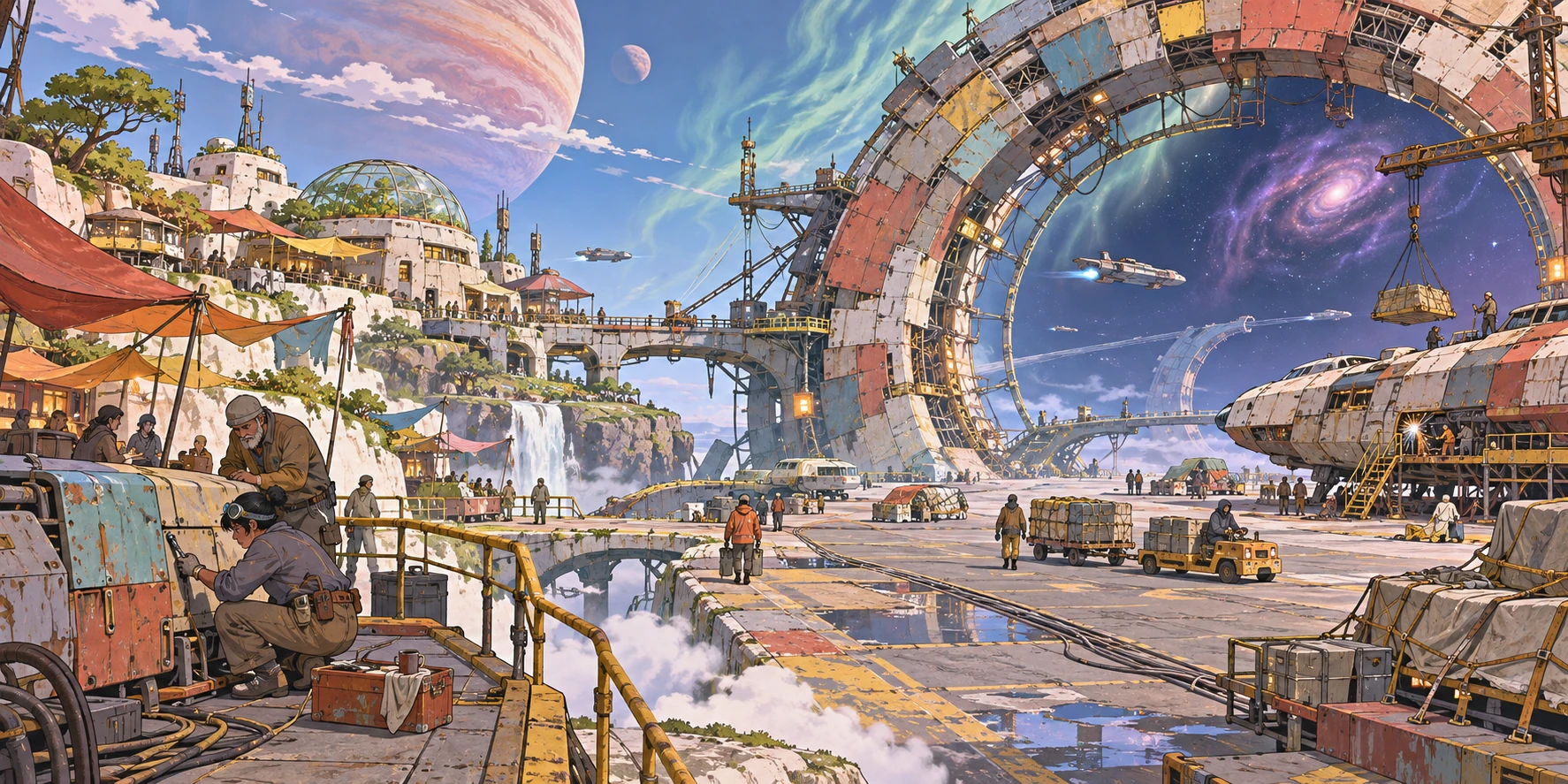
The Hinge is a port with uneven air. The Orchard of Unsent Names is a memorial that can be visited without surrendering grief. The Last Flower Field is both a historical wound and contested land.
Mend Lane offers a smaller neighborhood east of the shared square: a message shop, a lending shelf, rest chambers, cistern steps, a condensate bend, and a communal awning yard. Dema Rill, Pell Varo, Oru Sen, and Leth Arda join its established neighbors. The Evening of Borrowed Shade and the proposed story A Street With Room for Air follow celebration, access, paid work, and the uncertain survival of Seam moths.
Narrative paths
The Cup That Stayed Warm follows an ordinary day of repair and loss. The Garden Without Permission opens a longer conflict about created life and departure. Narrative Principles guides how these lives enter the newspaper and comic.
Visual language and architecture
The era is depicted through repaired cosmic everyday life: fine contours, open compositions, broad color fields, and architecture shaped by use and care.
- Visual Identity defines drawing, scale, and artistic tone.
- Palette and Tonal System provides color anchors and tonal hierarchy.
- Lighting and Emotional Color connects illumination to place and dramatic attention.
- Architecture and Material Grammar describes construction, wear, and repair.
- Civilization Architecture differentiates Veyr, Serein, Orun, and Meridian spaces.
- The Hinge Spatial Guide fixes recurring neighborhood and interior relationships.
- Characters and Everyday Objects records identity constraints and prop language.
- Visual Continuity and Production defines reference packets and publication checks.