A proposed neighborhood story on Mend Lane, before The Evening of Borrowed Shade. The setting notes establish the people and material conflict; the scenes and outcome below remain proposals.
Opening
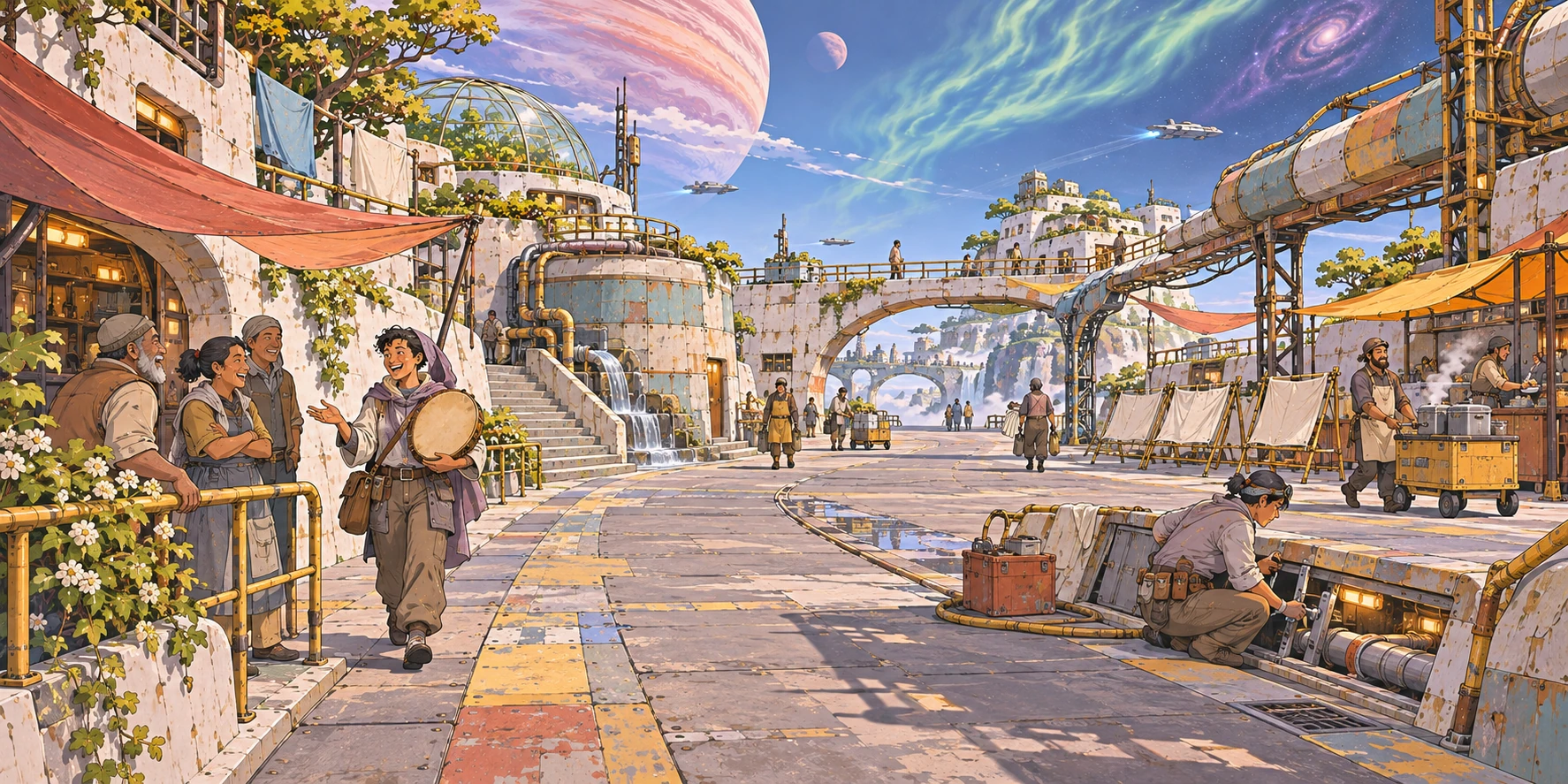
Oru Sen reaches the cistern steps carrying a percussion frame. Their hood is nearly empty because three neighbors stopped them to say how pleased they were about the coming air upgrade. They cannot stay for the canopy rehearsal.
While taking down an old fabric, Leth Arda finds eggs beneath the condensate guard. Dema Rill mistakes the first drawing for another objection to the crew booking. Leth has brought the drawing folded inside an unpaid invoice.
How the problem travels
Dema needs a decision before the crew’s cancellation deadline. Ilyra Venn initially proposes keeping one old return active. It would preserve the humidity variations on the route Oru needs; Oru asks her to walk the whole route wearing their hood before calling that temporary arrangement acceptable.
Sava of the Ninth Graft examines Leth’s records and identifies gaps rather than a reassuring answer. Leth hears dismissal where Sava means uncertainty. Later, Sava needs one of the supposedly useless sketches to locate an emergence site.
Pell Varo has taken canopy deposits. Moving the gathering into smaller rooms would strand some commissioned work and require refunds. Pell tries calling it an intimate edition of the event. Nobody is fooled, but two customers still want the cloth.
Nacre offers to test a layout for a separately ventilated breeding branch. A committee member asks whether their history makes them especially qualified to speak about displacement. They leave the meeting. Their objection does not erase the useful route measurements they had already supplied.
Teren Ash agrees to feed the installation crew for a paid shift. Dema insists on retaining the wages of a worker whose task may vanish if the design changes. The budget becomes a set of named commitments rather than an abstract obstacle.
A possible working plan
Improve the public route on schedule while retaining an isolated section of the old housing as a trial habitat in the service recess. Give it its own controllable air cycle and drainage. Do not assume it can survive independently until the test demonstrates that.
The recess is already used for drying frames. Relocation requires negotiated laundry hours, not discovery of a conveniently empty room. Leth makes ceramic inserts on paid kiln time. Oru offers limited chamber access for preparation; Dema is responsible for returning it clean.
The crew installs accessible inspection points. Ilyra trains another worker and does not make herself the sole person able to repair the branch. Maintenance funding covers a defined observation period; renewal remains a future decision.
A partial trial fails: adults feed on the new inserts but eggs laid there do not develop. Keeping some original material becomes necessary. Moving it risks losing part of the colony and changes the installation sequence.
Possible ending
The public route opens. The shade gathering is smaller because money and labor went to the branch. Some people prefer it; Pell is tired of hearing that this proves the original plan was excessive.
Oru plays while Teren is still serving. Nacre’s dessert leans, survives, and becomes the evening’s most photographed object only after Nacre agrees. Sava explains a botanical joke to someone who was laughing at the dessert.
Weeks later, Leth sees emergence in part of the retained housing. This is evidence of one surviving cycle, not proof that the whole colony or the new arrangement is secure. Another monitored section remains empty.
The last scene follows Dema and Oru returning washed canopy panels. Oru pauses in the lane to finish a story without checking the hood reservoir. Dema listens, holding a cloth too large to fold alone.
Continuity
No outcome settles Nacre’s imperial record, Enna’s fate, or the greenhouse departure conflict in The Garden Without Permission. The story uses local engineering; it establishes no universal atmospheric technology. The moths’ uncertain survival and Oru’s access are both material consequences, and neither neighbor is required to become a symbol for the other.