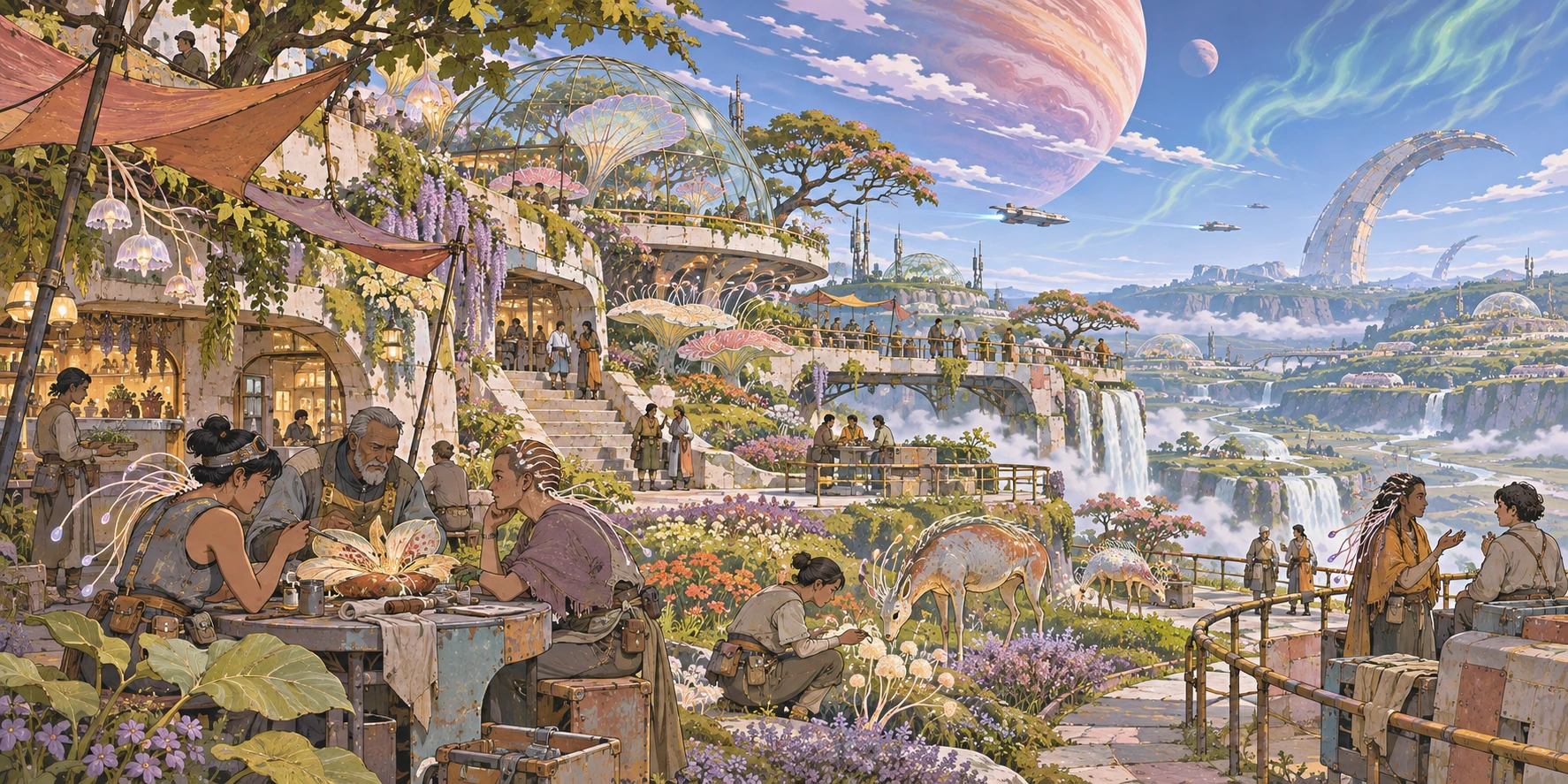
The Serein Gardens are overlapping communities of people whose living bodies can extend through grafted tissues. Most have a mobile core with branching sensory filaments. Some participate in wider biological networks by choice. A network is not automatically a single mind, and leaving one is not automatically death.
Serein habitat design combines long observation with powerful biological technologies. Their terraces support organisms with needs unfamiliar to visiting engineers. They can design new life forms; they cannot infer a life’s consent from the fact that they designed it.
A Serein name records an accepted relationship rather than a fixed family line. Sava of the Ninth Graft retains her ninth affiliation because the people in it helped her survive a winter, not because they own her subsequent life.
Their cultural beauty is slow and participatory. Buildings flower on different schedules, scents provide wayfinding, and songs can be performed by neighboring plants as well as people. Public translations acknowledge that a smell may carry associations no written gloss reproduces.
During The Narrowing, imperial authorities treated many Gardens as farms rather than inhabited communities. This history left a sharp suspicion of outside measurement. That suspicion can also make necessary criticism difficult: outsiders are not wrong merely because earlier outsiders were cruel.
Some Gardens grant a created organism room to change its intended function. Others quietly select against inconvenient traits. The Garden Without Permission emerges from this unresolved conflict.
The Gardens’ tenderness is not uniform. They have vanity, rivalries, neglected dependents, practical jokes, and arguments over whether a neighbor’s beautiful wall is blocking everyone’s light.