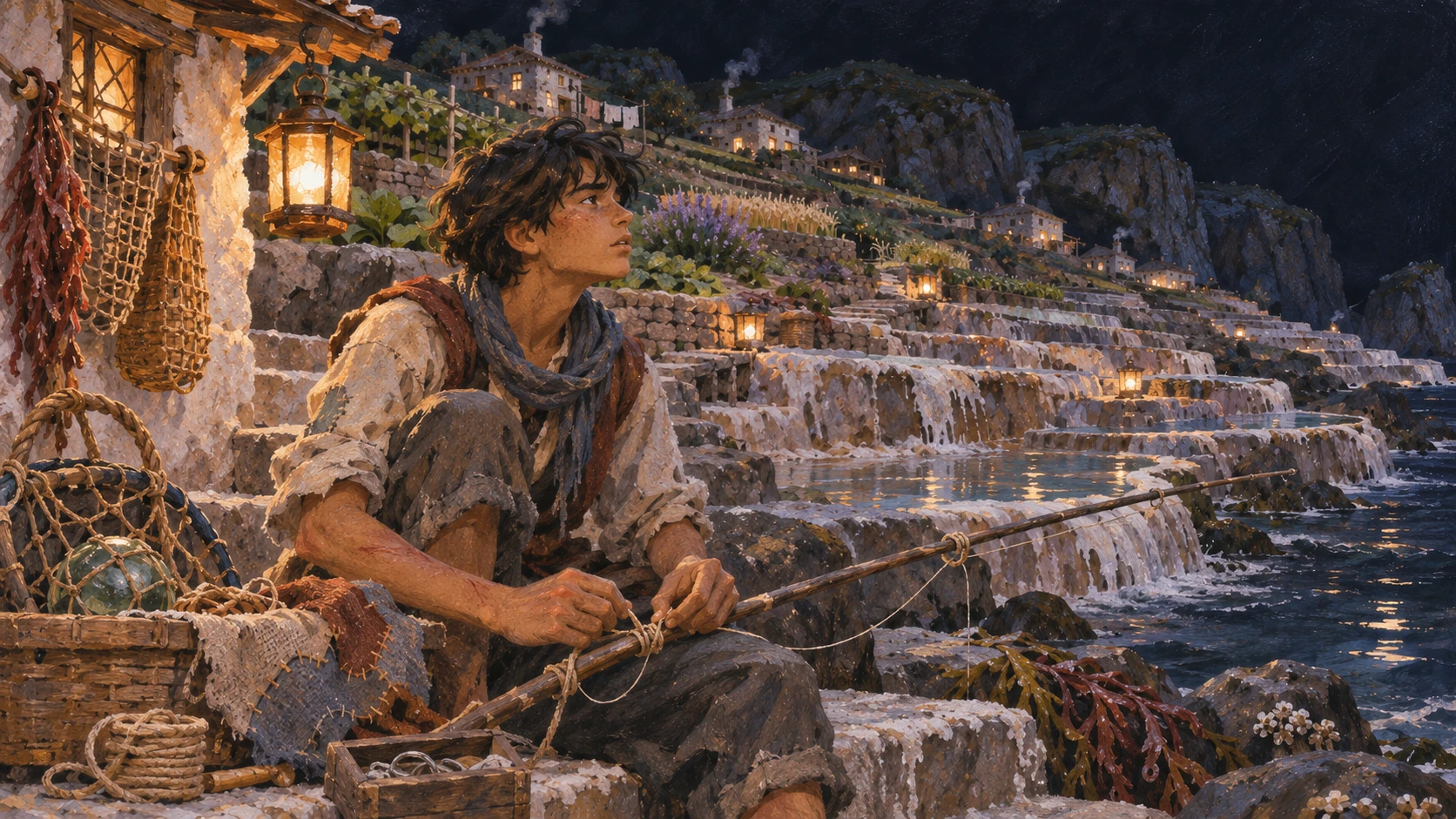
Arel is sixteen at the beginning of The Fisherman’s Apprentice. He lives at Brine Steps with his mother, Mara, who repairs sacks and keeps careful household accounts, and his eight-year-old brother, Nilo.
At the bread door he gives away his portion and leaves another child publicly embarrassed. At home he must face Nilo’s waiting bowls. He asks his mother why she is not angrier, then sees the thread catching in her split skin.
He works with salvaged material, rises before the household, and keeps looking past the school map’s border. When the book vanishes he runs before asking enough questions. His brother learns to hide an injured hand from him.
These actions carry his inner life. The manuscript should not replace them with labels declaring his compassion, ideals, or moral worth.
He finds The Fisherman’s Notes, makes a rod and raft, and discovers fishing through effort rather than an unexplained inherited gift. He also encounters the ethical difficulty of killing a living animal for food.
His relationship with The Little Dream Merchant begins with a pearl pouch caught on his line. His journeys with The Traveling Fire introduce affection, grief, practical help, and the limits of the contempt he carries.
His anger at The Tree at the Center is not treated as evidence that he never loved anyone. It arises from his refusal to accept suffering as a convenient instrument of another being’s purpose.
His brother and the neighborhood
02 Room for One More brings his ideals into conflict with his treatment of Nilo. His impatience becomes public cruelty before he has recognized it. He must repair trust through changed conduct, not through a claim that his intentions were good.
Children of Brine Steps are participants in his undertaking, not simply recipients of future generosity.
Beyond the border
Brine Steps teaches a map that ends at the landing and calls itself the world. Arel follows the book’s practical possibilities while searching beyond that inherited boundary. His questions do not make him incapable of imposing boundaries on Nilo or misunderstanding strangers.
Render his questioning through things he touches, tries, loses, carries, and cannot look away from. Tears, sleeplessness, anger, humor, and bodily hesitation belong in scenes rather than a repeated explanation that he burns with ideals.
Knowledge at the crossing
Arel does not recognize that he has crossed between faces when he retrieves the pearl. He surfaces at his own raft and explains unfamiliar land through an ordinary navigation mistake. His first question about the moon belongs to a campfire conversation, not an instant revelation. Chapter 7 is where several encounters let him revise his account of the world.