This proposed restaurant occupies an ordinary leased room near the public translation workshops of the Listening Anchorage, within The Confluence of Nine. The restaurant, lease, staff, and regulars are exploratory additions to The Age of Many Horizons.
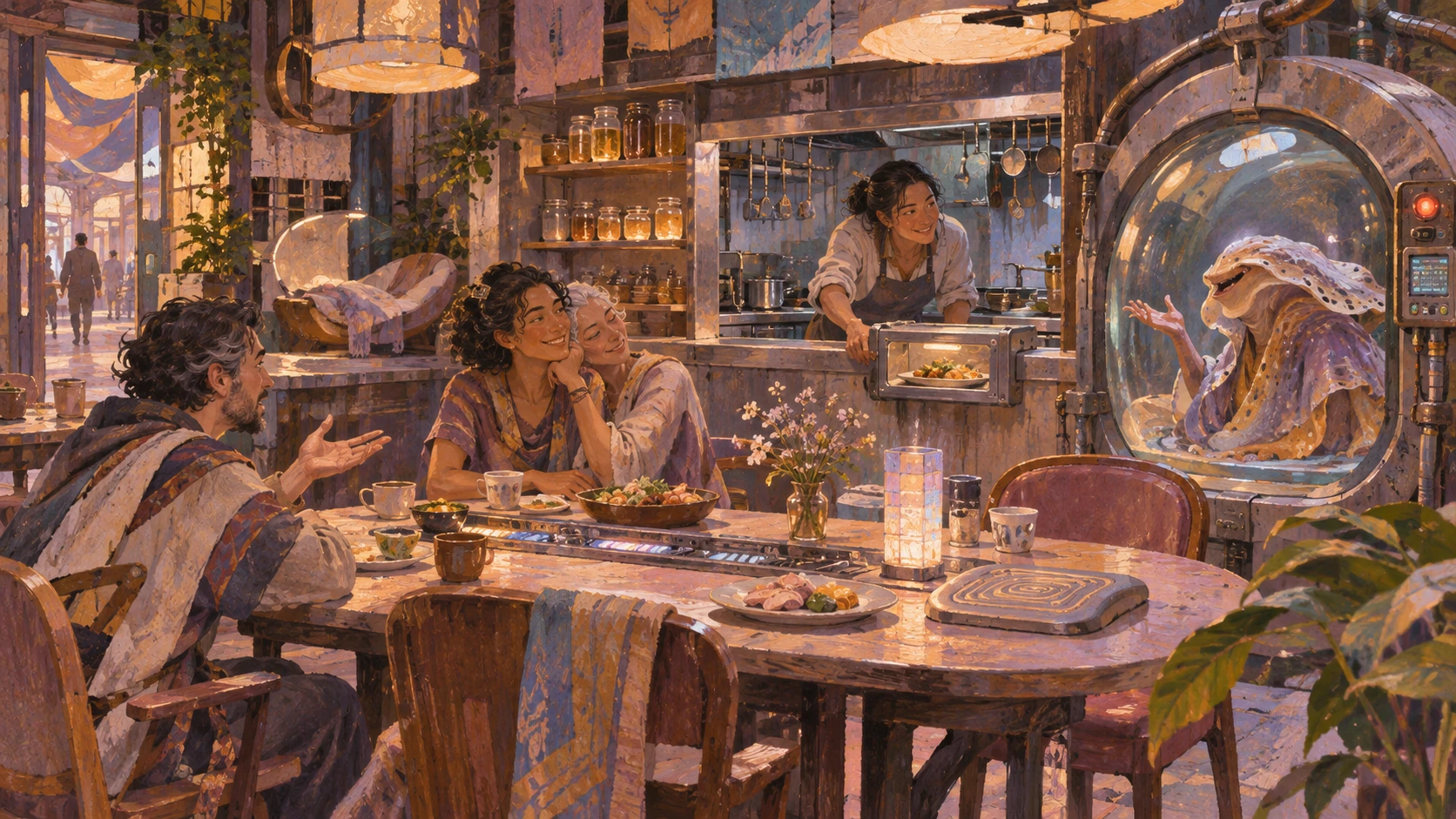
From the corridor, it looks like someone has arranged six unrelated pieces of furniture around a narrow opening. Inside, the opening proves to be the kitchen pass. Seats, a shallow rest cradle, and a pressure chamber face it. A visitor can see the cook’s hands without having to share the cook’s atmosphere.
Vessa Tor wants people with incompatible bodies to have supper together. Her equipment serves a small, explicitly supported range of conditions. Some guests cannot safely enter; others can attend through a communication instrument but must eat elsewhere. A booking begins with an individual conversation, not a species label. The restaurant cannot maintain every atmosphere or translate every sense.
A room with a working edge
The wet preparation bench and dry serving rail have separate tools and return paths. The pressure chamber has its own life-support controls and independent emergency signal. Guests can interrupt the entertainment without interrupting the habitat. A narrow movable bridge carries dishes to the kitchen side of each sealed serving drawer; food never travels openly across an atmospheric boundary.
The public table contains a removable mechanical sound strip. Compatible guests can hear it; others can touch a linked vibrating pad or watch a light sequence. These presentations share a schedule rather than a guaranteed meaning. A Menu for Several Bodies records how Vessa tests those correspondences.
Ordinary food is readily available in much of the Anchorage. The restaurant’s limited resource is Vessa’s time, followed by compatible chamber hours and specialist maintenance. Bookings cover that work. A modest shared supper is possible, but a new environmental requirement needs a separately agreed trial; buying the most elaborate dish does not buy an improvised habitat.
Three regulars
Halen Vesk comes after inspecting archive housings. He wants a quiet meal and invariably starts an argument about presentation. Omi Tal brings two intermittently synchronized bodies on some evenings and one on others. Vessa asks which experiences they currently share rather than treating a familiar name as an answer.
Besh, the third regular, repairs pressure valves and occupies the shallow chamber. Their active body is a flexible layered mantle that maintains its shape under compression. They eat suspended mineral-organic particles from a sealed cartridge, without which the evening’s beautiful pressure patterns provide no nourishment. They want to become a confident comic storyteller, but explain the technical basis of every joke before reaching its ending. Their favorite habit is tapping twice on the chamber window when someone has accidentally said something funny. Besh and Halen quarrel over volume, then reserve adjacent places. Besh pays Vessa to maintain the chamber and refuses to become its unpaid permanent inspector.
An evening to enter
The Evening the Table Would Not Sing follows a failed shared presentation. No catastrophe is needed: a repair appointment, a hungry guest, and Vessa’s reluctance to abandon an attractive idea are enough. Further stories can return to chamber bookings, Omi’s changing tastes, or Besh’s first successful joke without making every supper a referendum on civilization.