The first thing Arel learned from the fisherman’s book was that a knot could look obedient and still betray him.
He pulled one tight, held up the joined wood, and watched it fall apart.
Nilo laughed.
Arel looked at him.
“I thought it was finished,” his brother said quickly.
“So did I.”
That should have been the beginning of a joke. Instead Arel bent over the thread and tried again.
For three days, the courtyard became a place of measurements, scraped knuckles, and things that were almost useful. Nilo brought a short stick, a rusted nail, bits of string, a piece of wood painted blue on one side. Arel rejected them so efficiently that his brother stopped putting them in his hand.
They appeared beside the door.
Oren arrived with a proper plank. He was twelve and carried it high on his shoulder, turning sideways to enter as though the doorway had been built too small for his importance.
“Behind the cooper’s. He said I could.”
Arel ran his fingers along the grain.
“This is good.”
Oren looked at Nilo.
“Some things need to be found properly.”
Nilo pushed the blue wood beneath his other scraps.
Bessa brought a broken buckle. Her little brother Pavi followed her, catching up whenever she stopped.
“My mother says this is for the bread.”
“You don’t have to—”
“She says don’t make a speech.”
Arel accepted the metal.
Oren asked what the hook would do.
“Catch a fish.”
“And then?”
“Bring it home.”
Oren laughed. “Does it know the address?”
Bessa looked at the book.
“Is that really a cooking pan?”
Arel showed her the drawing.
For a while the children bent over it together. They knew pots, onions, knives, plates. Here was something familiar being done with something that had never belonged to it.
Pavi was troubled.
“Does it stop swimming?”
“Yes,” Arel said.
“How?”
“We’ll find out.”
Bessa looked at him over Pavi’s head. He turned to the raft before she could ask another question.
Work grew slower as the dream grew larger.
Arel had begun rising before the others. He carried a board to the wall and worked until Mara called him in. Once she found him sitting beside a finished joint with the wood still in his hands.
“Are you hurt?”
He shook his head.
“Then what is it?”
He put the joint down and reached for another board.
Bessa wanted to know why four narrow boards were better than two broad ones. Oren declared four more seamanlike, though none of them had ever heard the word until he invented it. Nilo asked who had taught the person who wrote the book.
“Can we finish one thing?” Arel said.
The children fell quiet.
Bessa set down the buckle. Oren rubbed a mark from his board. Nilo gathered the short pieces of string without asking which should be kept.
Arel took the silence for permission to work.
The loose page worried him. He put it back every night, and every morning it slipped free. At last he went to ask Dema for paste.
She had no paste. She had advice about keeping paper dry, a story about a clerk who had glued a sleeve to a table, and very little sympathy for his impatience.
When he returned, the book was gone.
He searched beneath his coat, inside the cabinet, under the mat. Each empty place made the next search rougher.
Mara was washing a sack.
“Nilo?”
“At the landing.”
“With the book?”
“I didn’t see.”
He ran.
The children had made a little raft.
It sat on dry stone above a tide pool, crooked, tied with too much string. Bessa knelt beside it. Oren had a loose end in his teeth. Pavi was walking along the boards, his arms stretched out.
Nilo held the book.
When he saw Arel, his face opened.
“We made the one for trying.”
Arel took the book from him.
The loose page slid forward. Its corner was folded. A wet mark crept into the margin.
“What happened?”
Nilo reached to show him.
“That’s where the knot—”
“Why is it wet?”
“The water came up a little.”
“You took it down here?”
“We kept it on the step.”
“Do you know what happens if it washes away?”
Nilo looked at the pool.
“I was holding it.”
“With those little hands?”
The words landed before Arel heard them.
Bessa stood.
“He wanted to learn.”
“He could have waited.”
“He has been waiting.”
Oren began gathering the boards.
“I’ll take these back, then.”
“Leave them.”
“They’re mine.”
“Put them down!”
Pavi lost his balance. Bessa caught him before he struck the stone.
For a moment there was only the sound of water in the pool.
Arel turned to Nilo.
“One thing. I ask you to leave one thing alone.”
“I thought—”
“Go home.”
His brother looked at the book.
“Go home. Stay out of my way.”
Oren gave a small, ugly laugh.
“Babies don’t go on boats.”
Nilo turned. His heel caught a board, and he threw a hand against the wall to stop himself falling.
A scrape. A sharp breath.
Arel reached for him.
Nilo put the hand behind his back.
“Don’t.”
It was barely louder than the water. Yet Arel stopped.
His brother climbed the steps without looking at anyone.
Bessa bent to gather the string.
“The page was already loose.”
“I know,” Arel said.
She went still.
He stared at the page. No words had been lost. He could still read every one.
At home, a piece of paper fell out of the book.
It was not the fisherman’s.
Nilo had drawn a raft with four boards, then gone over their edges until they were much wider. There was a place marked A at the front. Beside it, close enough for the figures’ hands to meet, a place marked N.
Underneath sat a little boy with mismatched shoes and a round stomach.
Arel pressed the drawing flat.
Outside, Mara was cleaning Nilo’s hand. He stood in the doorway while she picked grit from the scrape. His brother kept his face turned away.
“Is it deep?”
“No,” Mara said.
“I could help.”
“I have it.”
Nilo breathed in sharply. Mara paused, waited, continued.
Arel went inside. He opened the book and tried to read the instructions about joining wood. The words made sense. He could do what they asked. He could put this end through that loop and pull until something held.
He looked toward the doorway.
He reached for the loose page and remembered the keeper’s knife on the counter, the queue waiting, the woman unable to move until he finished.
His own finger had been pointing today.
He curled it into his palm.
He put the book down.
The worst part was how reasonable he had felt.
Nilo was adjusting the cabinet’s stone that evening. He pushed it with his good hand, stood back, and pushed again.
Arel crouched.
“I’m sorry.”
Nilo inspected the gap beneath the cabinet.
“I shouldn’t have shouted.”
No answer.
“Oren shouldn’t have said that.”
Nilo looked at him.
“You said it first.”
“I didn’t call you a baby.”
“You said my hands were little.”
Arel lowered his eyes to those hands. One still had grit-darkened lines near the bandage.
“They’re not too little to help.”
“They were today.”
Mara’s knife struck a chopping board outside. Arel counted the strokes because he could not find a reply.
“Does it hurt?”
“Yes.”
“Can I look?”
“Not now.”
“All right.”
He sat against the wall.
Nilo had always come to him with injuries. Splinters, bruises, scratches, things too small for anyone else to stop working over. Arel would turn the hand or foot toward the light. Sometimes he had found nothing, but his brother stayed beside him until it felt better.
There was something to see now.
Nilo would not show him.
They remained by the cabinet until Mara called them to eat.
The next morning Bessa brought another drawing.
“I found it under the boards.”
This raft was crowded. Oren had shoulders as wide as a door. Bessa held a paddle shaped like a spoon. Pavi sat in the middle. Arel stood at the front.
Nilo had put himself at the back, facing everyone else.
“He made several,” Bessa said.
“It won’t carry all of us.”
“I know.”
“A real raft—”
“I know what you mean.”
He stopped.
“Pavi keeps asking when we’re going.”
“We aren’t going yet.”
“Tell him. Nicely.”
She took the rusted nail from the table.
“He wants this back.”
“I was going to use it.”
“You said it was too rusty.”
Arel let go.
After she left, he rubbed rough edges from the boards. He moved the tools out of the path between the door and the cabinet. He placed a stone on the book’s loose page so nobody would have to hold it down.
Then he called Nilo.
His brother stayed near the doorway.
“We could try the little raft.”
“I made one.”
“We could try yours.”
Nilo watched him.
“Bessa too?”
“Yes.”
“Oren?”
“If he wants to.”
“And Pavi?”
“He can watch from the dry steps.”
“Can I watch?”
Arel swallowed.
“Yes.”
“Maybe tomorrow.”
“Tomorrow—” he began.
Nilo waited.
Arel looked at the bandage, then at the doorway his brother had not quite left.
“Tomorrow, then.”
He sat down with the string. On the second pull, it broke.
Nilo heard.
“There’s some in my saucer.”
“It has knots.”
“They come out.”
Arel waited while his brother fetched it.
The knot he chose was old and dirty, its center pulled tight. He teased it with his nail. Nilo leaned closer.
“That part first.”
Arel changed his grip.
“Wait. Don’t pull.”
He waited.
They freed it together. When Nilo sat beside him afterward, there was still a little space between their knees.
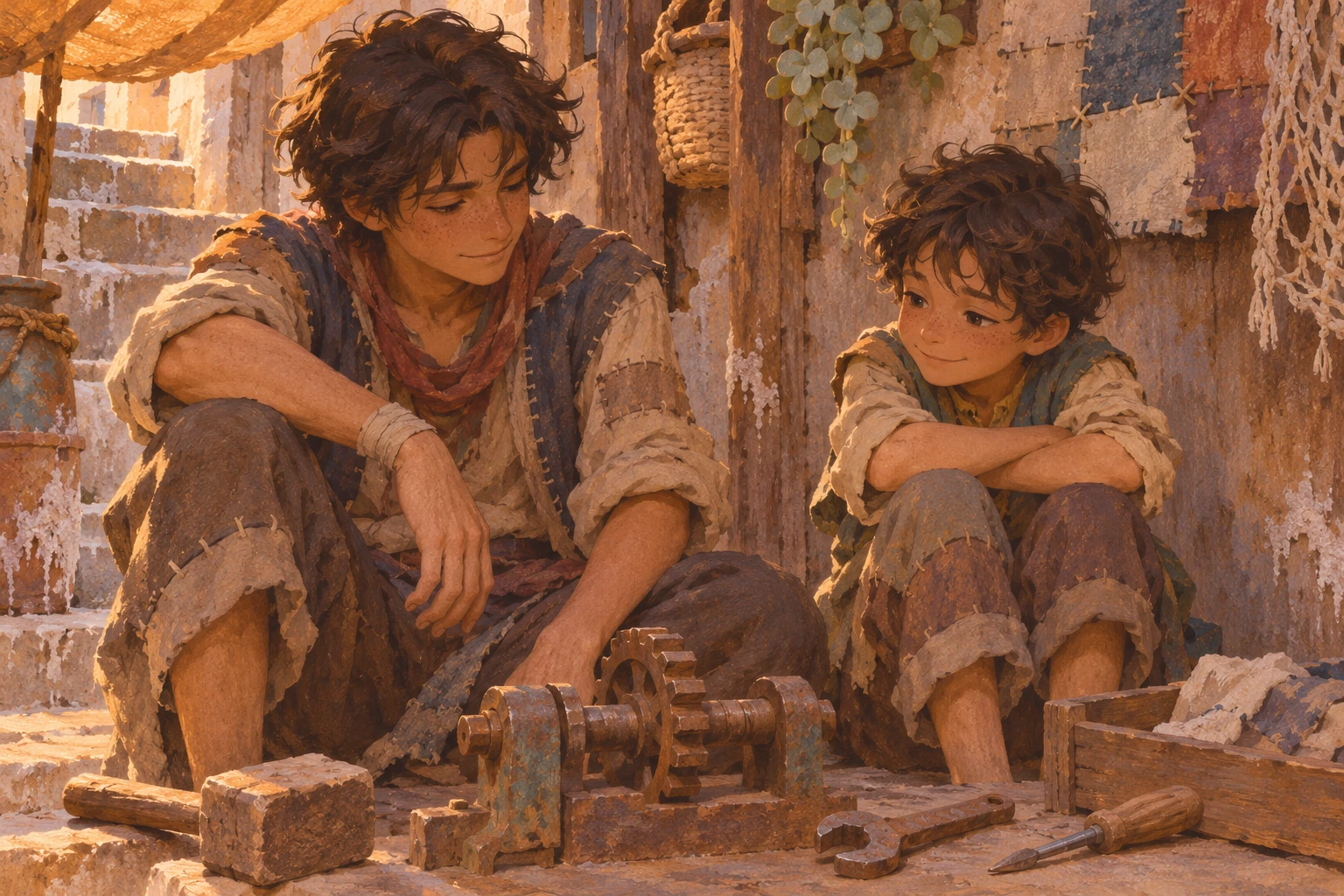
They took the little raft down the following afternoon.
Oren returned the boards without mentioning the taunt. Bessa helped steady them while Arel tied the joints. Pavi stayed on the upper step, inspecting his nail. Nilo chose a smooth pebble for the center.
Arel lowered the raft into the tide pool.
One side dipped. Water crossed a board.
Oren said it was the wrong kind of wood.
Nilo pointed.
“Move the stone.”
They moved it.
The raft steadied.
Arel kept his hand underneath for a moment, then drew it away. The crooked little thing remained afloat. Nobody spoke. It was the first time any of them had put something together that the water agreed to carry.
“Now a big one,” Oren said.
“When we’ve tried more,” Arel answered.
Nilo leaned over the pool.
Something silver passed beneath the boards.
Arel caught the turn of a body, a narrow tail, then nothing. It had vanished under the lowest step.
Pavi came down one stair.
“Was that it?”
Arel crouched. The water showed weed, stone, shadows.
The fish had gone under the last step. Arel leaned toward the dark gap. It continued beyond what he could see, toward water no classroom border reached.
Pavi lowered his nail.
“Perhaps it lives there.”
“Perhaps it goes somewhere,” Nilo said.
He moved closer.
Nilo caught his sleeve with his good hand.
“Don’t frighten it away.”
Arel stayed still.
They watched until their reflections settled on the water.
The fish did not return that afternoon. But when they climbed the steps, Arel was already thinking about the pole, the line, and the drawing of the curved metal.
Nilo walked beside him.
This time, when his brother offered to carry the other end, Arel let him.