Nilo brought home a fish on the day they made the bread smaller.
It was a fish he had drawn, which disappointed him greatly.
“I found a real one yesterday,” he told Arel. “In the pool under the landing. It had a mouth.”
“Most things do.”
“Then why doesn’t it come up for bread?”
Arel was trying to stitch a loose strap back onto his sandal. He pulled too hard and broke the thread.
“Because it has more sense than we do.”
Nilo considered this. He was eight, and still believed a question ought to lead somewhere. He turned his drawing over and began giving the fish legs.
Their mother called from the courtyard. Arel was to fetch the bread, then bring home the narrow cabinet from the old storehouse. “And don’t come back with another argument,” she added.
He came back with an empty basket.
At the bread door, a woman in a blue-mended coat stood on a stone to read the new notice. Her small boy rubbed his mismatched shoes together. Behind her, the queue reached far enough down the street for Arel to see the sea between a wall and a shutter.
The school map ended at the landing. Above its streets and five fields, in letters larger than any house, the teacher had written THE WORLD.
Once Arel had asked what lay beyond the water. The teacher said the map contained everything they needed. The next morning he had sent two boys out to beg for lamp oil.
Now a man in the queue reached past Arel and pulled the shutter closed. The strip of sea disappeared. The line moved forward.
“What does it say?” he asked.
The woman stepped down.
“Less.”
The door opened. The keeper counted her coins, cut a piece, and went to call the next name.
“That won’t feed both of them,” Arel said.
The keeper held up the knife. “Shall I cut it longer or wider?”
“Bigger.”
“Which of the people behind you shall I cut smaller?”
Arel glanced at the queue. Nobody volunteered. A man wearing a coat with polished buttons looked away first.
“Mine.”
The keeper gave the woman Arel’s portion as well. For an instant, Arel felt splendid. Then she refused to pick it up.
“I didn’t ask you to exhibit us.”
Her little boy stood very still.
“I’m trying to—”
“I know. Must I stay here while you finish?”
Arel put the bread into her basket. The man with the buttons muttered that someone would have to teach the boy manners. Arel nearly answered him. The woman’s hand closed around her basket handle, and he swallowed what he had been going to say.
On the way home he stopped beside a wall and pressed the empty basket against his stomach. He had wanted to hit the man with the buttons. He still did.
A child passed carrying a bowl with both hands. Arel moved aside. At the next doorway another child sat scraping the bottom of a pot. He waited for the spoon to find something. It kept making the same sound.
He walked faster.
Then he reached the courtyard, where Nilo was waiting with two bowls.
“Did you get it?”
Arel looked at the bowls.
Mara listened while sewing a sack. Nilo put the bowls away without stacking them; the noise would have sounded too cheerful.
“Somebody should do something,” Arel said.
“Yes.”
“Something besides getting used to it.”
Mara drew another stitch through a patch that had begun to give way.
“You could at least be angry.”
“Hold this.”
He took the sack. A small split beside her thumbnail caught the thread each time she pulled it. The rough skin was dark with old blood.
Arel kept his eyes on her hand.
“Does it hurt?”
“It does.”
He had wanted an argument. She had given him a corner of cloth to hold and nowhere to put the speech he had prepared.
“There is broth,” she said when the seam was finished. “Leave some for tonight. The cabinet first.”
Nilo offered to come.
“The thing will be too heavy,” Arel said.
“I could open doors.”
“We haven’t got that many doors.”
His brother smiled because it sounded like a joke. Arel left before he had to decide whether it was one.
The storehouse stood above the landing. Old people said it had once held equipment. What kind, nobody seemed to know. They knew precisely which neighbor had stolen a washing basin eleven years earlier, but a beam carved with strange shallow vessels had outlived everyone’s explanation.
Arel passed beneath it. The carvings looked like bowls with nowhere to set them down. Every vessel pointed toward a gap where a larger shape had been cut away. Someone had later scratched a border around the little boats. He ran his finger along it. The border did not belong to the first carving.
Inside, sunlight entered through broken roof tiles. Three doors leaned against a wall; a bed frame had lost a whole side; a basin had kept its handles and misplaced everything between them. The cabinet faced the rear wall as though the rest of the furniture had offended it.
He pulled. A foot caught in a crack and snapped.
He kicked the broken wood. Pain shot through his toe.
“Did it apologize?” called Dema from the landing steps.
She was shelling peas into a bag.
“No.”
“Furniture never does. That’s why it lasts.”
He crouched beside the cabinet. Behind it was a rectangle where the wall had remained pale. Something had been pressed between the rear panel and a warped plank.
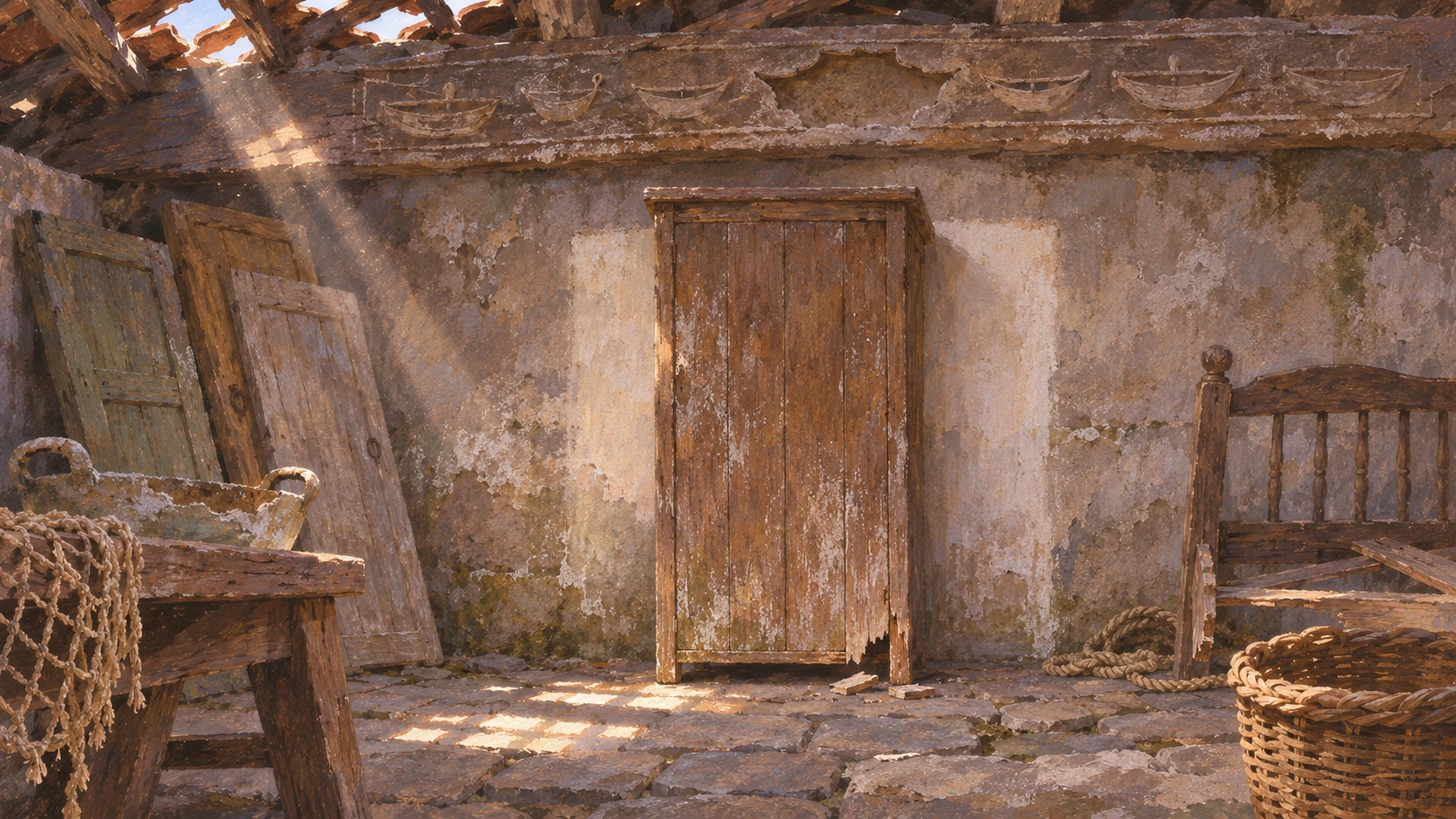
He pulled out a cloth bundle.
The outer fold crumbled beneath his fingers. Inside, the cloth was dry and the object had corners. A book. Its spine had been repaired with close-woven fabric; a dark stain ran down the cover.
Arel wiped it with his sleeve.
THE FISHERMAN’S NOTES
He read the words twice. They did not become more familiar.
The first page was missing. The next showed pieces of wood tied together, a little person sitting on top, and water all around.
He turned to a drawing of a pole and a line.
At the end of the line hung a fish.
This was odd enough. But on the following page the same kind of fish lay beside a bowl, a knife, and a cooking pan.
Arel leaned so close his nose almost touched the paper.
Someone had drawn a fish with onions.
He thought of the broth at home, of Nilo wondering why a mouth did not come to the bread door. He turned backward, then forward. The fish had not acquired legs. There was no mistake in the order of the drawings.
He took the book to Dema.
“What would you do with one of these?”
She looked at the fish.
“Put it back.”
“No. Look.”
She examined the pan, moved her finger to the onion, and peered at the fish again.
“Well,” she said. “That explains why they hid the book.”
“Is it possible?”
“To draw an onion? I believe so.”
“To eat it.”
“Eat the fish?”
Her voice rose. Arel looked up the street.
“Don’t say it so loud.”
“Why? Will it hear?”
He spread the book across the step.
“The line catches it. Then they bring it home.”
Dema read the notes beneath the drawings. Her joking expression faded, though he could not tell what replaced it.
“My grandmother used to say the sea could set a table,” she said at last.
“Then she knew!”
“She said the wind could carry gossip too. We kept our washing indoors when she was annoyed.”
“Did you ask what she meant?”
“When she was here I wanted her to stop talking. When she wasn’t, I thought of questions.”
He sat beside her. The peas had stopped falling.
“Do you believe this?”
Dema returned the book.
“I believe we have sat beside a great deal of water for a very long time.”
It was not an answer, and he wanted to shake one out of her. Instead he opened the book again.
The writer had made mistakes.
Arel found a measurement scratched out, a knot redrawn, a warning about a line that had parted under strain. The person who made these pages had not received them from the sky. They had worked, failed, and come back wet enough to leave marks in the margins.
One loose page carried a list of names. Farther on, he found one of the names again:
Take food for her. She will tell you she has eaten.
The words caught him more firmly than any of the diagrams.
He laid the page beside his empty basket. It was difficult to keep looking at the two together.
In one drawing, the vessel had passed beyond a headland. On the school map, that headland was the last mark before the border. He turned the page, looking for what came next. The corner had been torn off. He held the ragged edge against the light, as if the missing coast might still be found in its fibers.
There was no answer on the next page. It concerned knots.
He looked toward the water. A gull landed on the farthest post, shook itself, and flew beyond the headland. Nobody called it back.
He kept watching long after it had gone.
He read until Dema asked whether the cabinet was walking home without him.
Mara stared at the page with the cooking pan.
“You’re quite sure it’s meant to be eaten?”
“What else is the pan for?”
“People put plants in pans. People put pans under leaks. Your brother uses one as a drum.”
Nilo came to look. He still carried his fish drawing.
Arel showed him the line.
“It catches them.”
Nilo frowned.
“Will they come?”
“It doesn’t ask them to come.”
“Then how will they know?”
Arel opened his mouth, closed it, and turned to another page.
Mara tapped a number.
“How long is that?”
He read the unit. Neither knew it.
“That can be worked out,” he said.
“And whether it floats?”
“That too.”
“And whether any of these pages are telling the truth?”
“I have to try.”
His voice cracked on the last word. He bent over the page so she would not have to decide what to do about it.
Mara watched him. He could hear Nilo turning his drawing against the table.
“Shallow water,” she said. “First.”
He looked up.
“No household cord. And you eat before you go anywhere.”
He tried to answer and had to clear his throat. Mara turned toward the pot, giving him time.
Nilo asked where he would sit.
Arel looked at the small figure on the raft.
“There isn’t room for two in this drawing.”
“You can draw more room.”
“Wood doesn’t work like paper.”
Nilo lowered his fish. A moment later he went to find a stone for the cabinet’s broken foot.
That night Arel made a list.
Wood, a line, metal, a pole. When the paper ran out, he turned it over. Nilo’s fish was there, with its awkward new legs.
He put down the pencil. Outside, someone laughed. The sound reached him through the wall and stopped. He wiped his nose against his wrist before taking up the pencil again.
On the other mat, Nilo whispered, “If it works, will Pavi have to eat his?”
“His what?”
“The fish. He might want to keep it.”
“I don’t know.”
“Could he keep one and eat another?”
“Go to sleep.”
The room settled. Mara put away the pot. Somewhere in the street, a man was still explaining why less bread was necessary.
Arel laid his hand on the book.
He remembered the list of names, the correction in the margin, the fish beside the onion. Somebody had once crossed the distance between an empty bowl and all that water.
He went to the window.
The shutter could hide the water from the bread queue. A border could stop it on the school map. He leaned out until he could see past the houses.
Somewhere beyond the headland there would be another morning. Someone might already be waking into it. He tried to imagine a kitchen there and found he was holding his breath.
Behind him Nilo stirred. Arel pulled the blanket over his brother’s exposed foot. Then he returned to the window.
Outside, the tide struck the landing. In the dark, it sounded much closer.