The Two Shores is a realized local universe with two inhabited faces and a central living structure. “Upper” and “lower” are inherited local descriptions, not a ranking within infinite existence.
The moonless shore contains Arel’s home, the settlement of Brine Steps. Its people do not venture onto the open sea and do not regard fish as catchable or edible. Sea transport survives only as ambiguous carvings and sayings. Their distance from fishing is a loss of conceivable practice, not merely a missing technique. Food comes largely from land cultivation and tightly controlled distribution. Roughness, prejudice, kindness, and fear coexist within households.
The moonward shore contains different cities, orders, small traveling companies, and independent associations. Many inhabitants consider the moonless peoples inferior. They disagree on almost everything else.
Crossing
The two faces have connected deep-water regions. Arel’s route includes both his dive and the surface occupied by his raft.
He pours the pearls into the water, dives, retrieves one, and surfaces beside the same raft. To him this is an ordinary sequence of swimming and returning. He encounters no visible portal, breathing pocket, blackout, or deliberate transit procedure.
After climbing aboard, he interprets an unfamiliar dark coastline as drift. He learns the moon’s name at a travelers’ fire and only later assembles evidence that he is on the other face.
The underlying local architecture permits this continuity of water and surface. Its exact mechanics are not established here, and Arel cannot initially explain them. This is a feature of this realized world, not a general property of oceans.
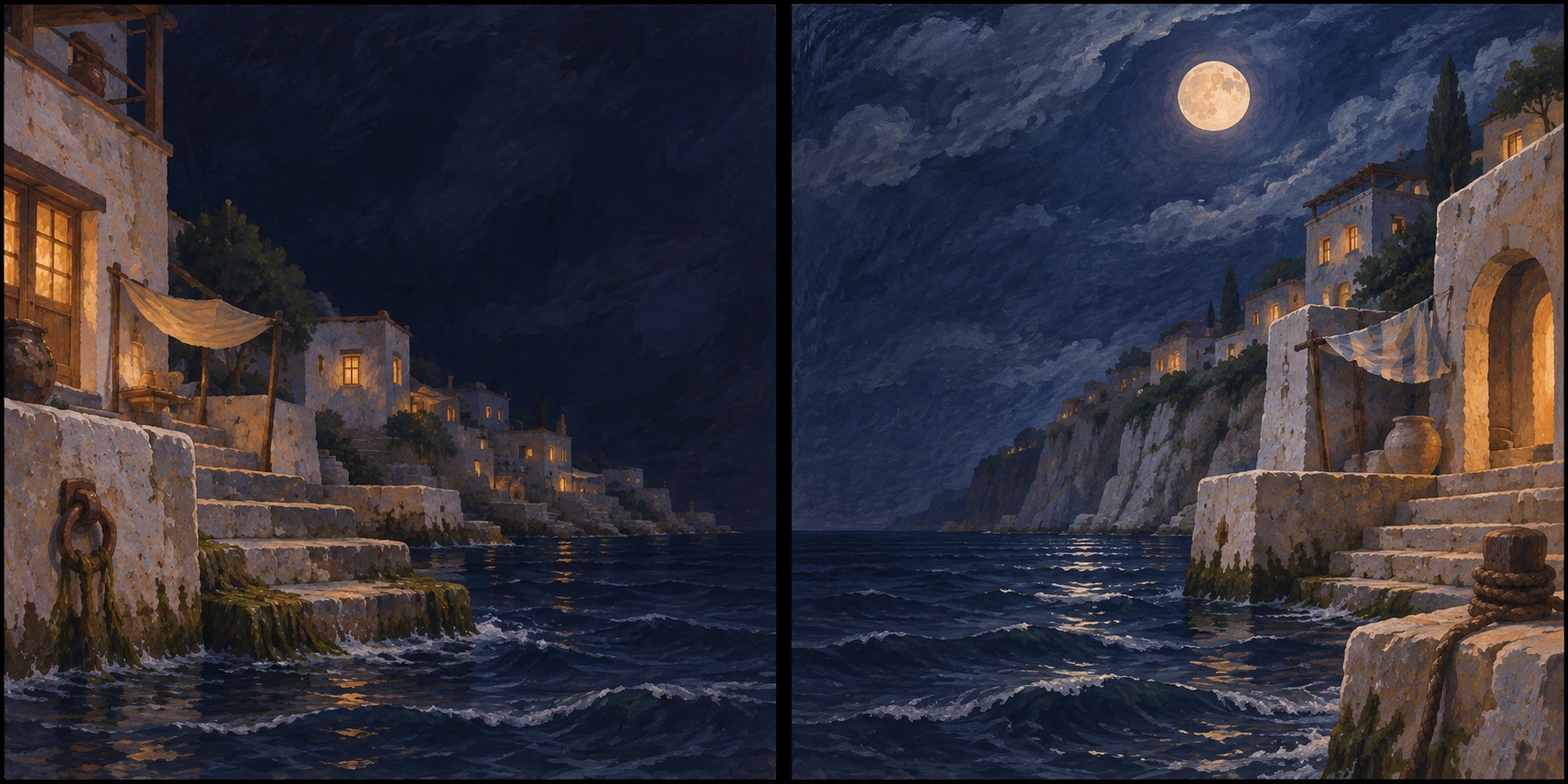
The moon
Moonward institutions maintain the moon’s local orientation through infrastructure inherited from earlier builders. Access to that infrastructure and its interpretation are political matters. The arrangement is not proof that the moon prefers them.
Sea travel and fishing are taboo in much of moonward public culture, where crossing is associated with contamination and loss of status. Some residents question the prohibition; others benefit from it or fear what questioning would cost.
The center
The central tree is reachable through interior routes, not simply by walking downward from any town. Its capacities are extraordinary but bounded to this setting. Its declaration that it could end suffering requires scrutiny; the story does not certify it as a universal theorem.