The Wandering Garden is a proposed local ecosystem whose rooted platforms move over a broad seasonal plain. Its era, inhabitants’ cultural affiliations, and connections to established locations remain unassigned. It has no established passage from The Hinge, Rillune, or The Confluence of Nine. The name is a visitor’s description, not a claim that someone planted or owns the whole.
At a distance, the garden resembles a low wooded ridge. Then a gap opens between two groves, and pale articulated feet become visible beneath a woven mat of roots. A carrier may stand still for days while another beside it turns toward a band of recent rain. Their accumulated movements produce a loose migration, not a convoy obeying one mind.
A place that can leave
The carriers support living root mats rather than loose soil piled on their backs. Shrubs grow around water pockets. Small grazers work along the edges, and fallen leaves collect in sheltered seams. Roots on Borrowed Feet explains the dependencies that keep the proposed system alive. Its creatures are neither transport machines nor a universal explanation of mobile habitats.
Some people walk beside the migration during part of its route. They pitch shelters on the plain and meet at designated stepping places when carriers are resting. A few trained tending households maintain removable work decks on mature carriers whose condition permits them. Loads, attachment points, and access are checked locally; a carrier can cease to be suitable even when its household wants to stay.
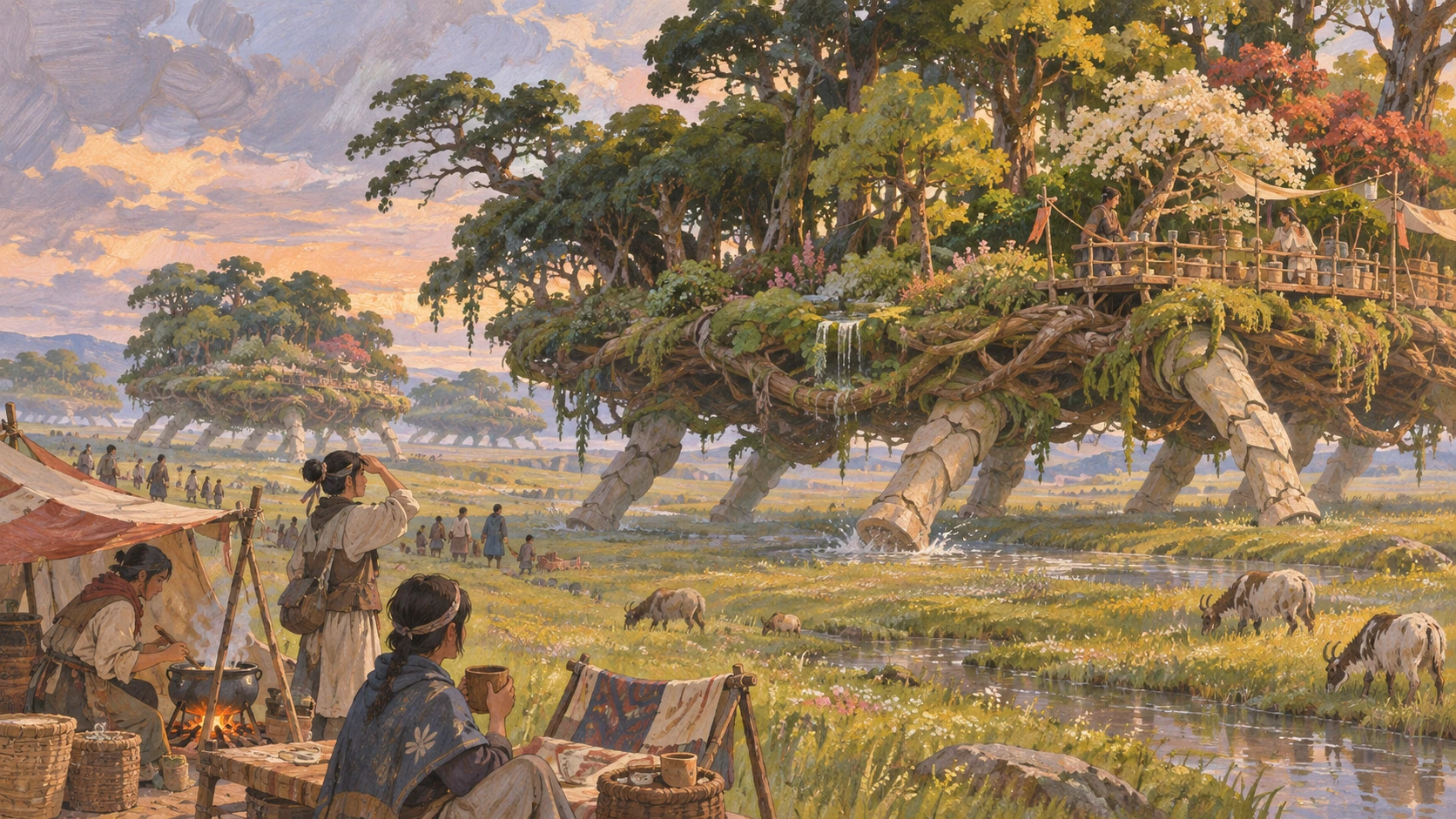
The garden offers pleasures that require no expedition: watching grazers choose between neighboring mats, collecting approved fallen seed cases, learning to recognize a carrier’s resting posture, or cooking under a grove that may be a valley away next season. At dusk the feet settle one after another. Cups on the work decks produce a brief, uneven rattle that residents call the evening applause.
Competing attachments
Tending households want continuity of work and dependable meeting grounds. Plain dwellers want access to water and protection for fixed gardens. Neither group has a complete account of what the migrating organisms need. A recently fenced spring could matter more than the destruction of an impressive grove, because several younger carriers depend on its mineral water.
Visitors often ask which carrier is the oldest. Residents are more likely to ask which one has stopped drinking. This practical attention should coexist with vanity, rival cooking traditions, and arguments over whose deck has the best view.
A Season Beside the Garden sets out an ordinary visit with real opportunities to leave. Waiting for the Amber Cup proposes a traveler looking for a particular blossom and slowly learning to distinguish its species, its rootstock, and their own memory of it.
The next development step would be a local map and measured seasonal conditions. Until then, routes are relative sequences, not precise distances on a planet already specified elsewhere.